Views: 258 Author: Dongguan PRES Publish Time: 2026-10-28 Origin: Site


Content Menu
● Top PEEK Pellets Manufacturers and Suppliers in Germany: Selection Criteria
● PEEK Pellet Supplier Comparison at a Glance
● 1. Dongguan PRES Group Co., Ltd.: OEM Sourcing for German Buyers
>> Where PRES Fits in a Procurement Strategy
● 2. Evonik: VESTAKEEP PEEK for Industrial Applications
>> Why Include Evonik in the Shortlist?
● 3. Ensinger: TECACOMP PEEK for Functional Compounds
>> When a Compound Specialist Makes Sense
● 4. Victrex: Established PEEK Grades for Molding and Extrusion
● 5. Syensqo: KetaSpire PEEK Across Multiple Formulations
● How to Choose PEEK Pellets for Injection Molding and Extrusion
>> Define the Operating Conditions
>> Choose the Formulation Deliberately
● A Practical Five-Step Supplier Qualification Process
>> Step 1: Send One Consistent RFQ
>> Step 2: Review Documents Before Ordering Trials
>> Step 3: Run Controlled Processing Trials
>> Step 4: Test Representative Parts
>> Step 5: Agree on Change Control
● Compare Total Cost, Not Just Price per Kilogram
● OEM Documentation and Compliance for German Buyers
● Request a PEEK Pellet Evaluation from PRES
>> 1. Is PRES a German PEEK manufacturer?
>> 2. Are PEEK pellets and PEEK granules different?
>> 3. Which PEEK supplier is best?
>> 4. Can carbon-fiber PEEK replace metal?
>> 5. Can any PEEK pellet grade become 3D printing filament?
>> 6. What should a German buyer request first?
Choosing among the Top PEEK Pellets Manufacturers and Suppliers in Germany takes more than comparing resin prices. Buyers need the right material grade, reliable documentation, consistent processing performance, and a supplier whose business model matches their project.
For German brands, wholesalers, and manufacturers, the shortlist can include both domestic specialists and international OEM partners. This guide places PRES first as a China-based OEM sourcing option, followed by established polymer and compound suppliers relevant to German purchasing teams.
The companies below are not interchangeable. Some manufacture base polymers; others develop compounds or provide OEM supply. Understanding that distinction is the first step toward a better purchasing decision.

This is a buyer-oriented shortlist, not an independently audited ranking by revenue, capacity, or customer satisfaction. PRES appears first because this guide is published from the company's commercial perspective.
The selection framework considers:
- Relevance to PEEK pellets and processing applications.
- Availability of identifiable material families or grades.
- Suitability for industrial sourcing discussions.
- Opportunities for technical documentation and qualification.
- Fit with OEM, distribution, or manufacturing requirements.
"Serving Germany" should not be confused with "manufactured in Germany." Buyers should confirm the production location, seller, importing entity, and delivery arrangements for every quotation.
| Company | Supplier category | Relevant offering | Main purchasing question |
|---|---|---|---|
| Dongguan PRES Group Co., Ltd. | China-based OEM supply option | PEEK pellets and broader high-performance plastic products | Can the proposed grade and OEM scope meet the specification? |
| Evonik | Polymer manufacturer | VESTAKEEP PEEK | Which grade fits the processing route and service conditions? |
| Ensinger | Compound developer and supplier | TECACOMP PEEK granulates | Which reinforcement or functional modification is needed? |
| Victrex | PEEK polymer manufacturer | VICTREX PEEK, including 450G | Does the selected grade match flow and performance requirements? |
| Syensqo | Specialty polymer manufacturer | KetaSpire PEEK | Which unfilled, reinforced, or wear-resistant grade fits? |
Local stock, distributor authorization, minimum orders, and delivery times require direct confirmation.
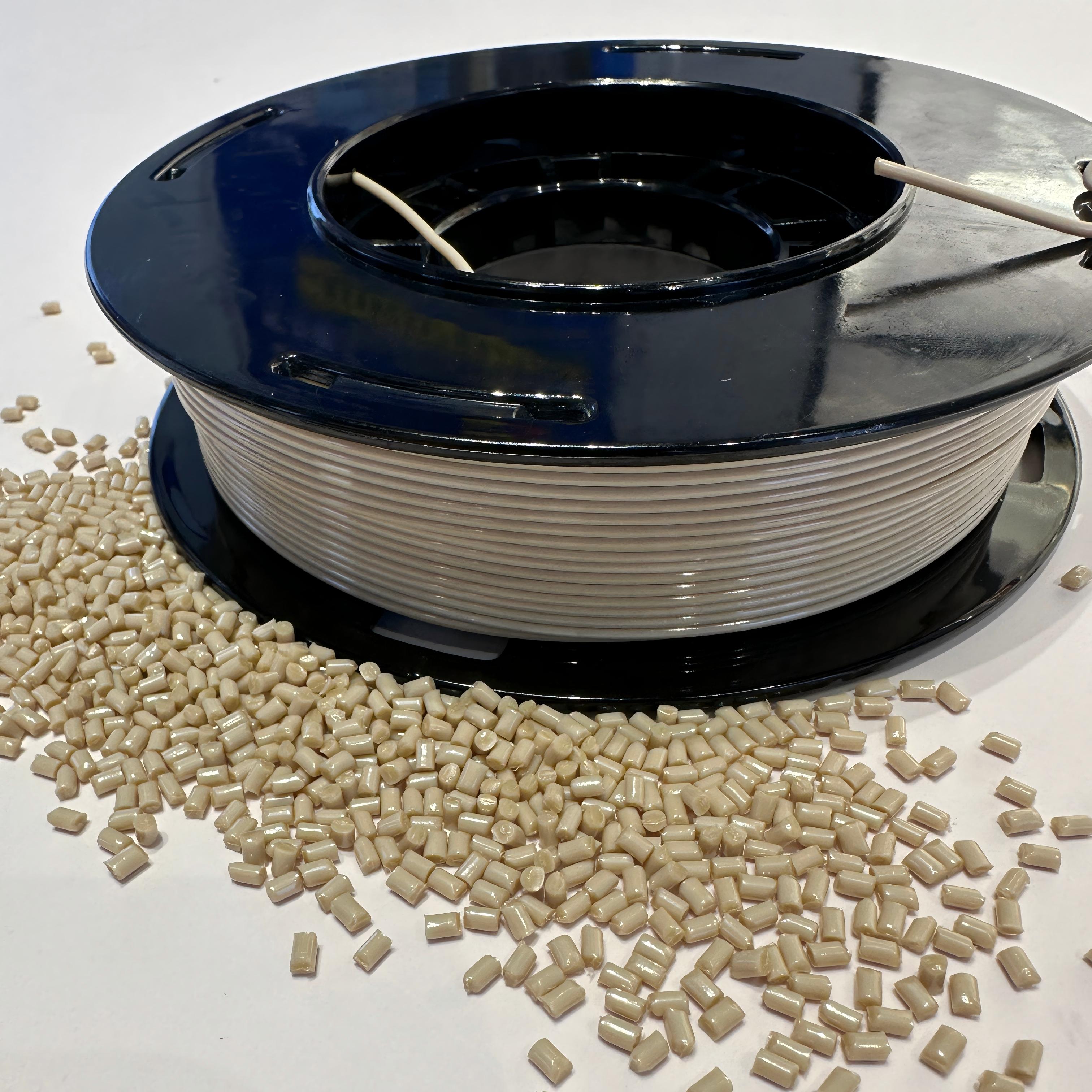
PRES is a China-based high-performance plastics supplier offering pellets, sheets, rods, tubes, powders, and high-performance 3D printing filaments. Its stated commercial focus includes OEM services for overseas brands, wholesalers, and manufacturers.
For German buyers, the relevant opportunity is an OEM discussion that connects material supply with broader product requirements.
PRES deserves consideration when a project involves several product formats or requires an OEM supply arrangement rather than only a branded resin purchase.
Potential sourcing discussions include:
- PEEK pellets for manufacturing trials.
- Reinforced material options for application evaluation.
- Semi-finished products for machining.
- High-performance filament requirements.
- Packaging, labeling, and documentation expectations.
These items should form the RFQ scope. They are not substitutes for confirmed contractual capabilities.
Before approving PRES, request a grade-specific technical data sheet, safety data sheet, sample quantity, production lead time, and proposed quality documentation.
Also clarify whether PRES manufactures the base polymer, compounds purchased resin, converts material, or supplies sourced grades. Each role creates different traceability and change-control responsibilities.
For an OEM relationship, put the approved specification, packaging requirements, inspection methods, and material-change notification process into writing.
Evonik's VESTAKEEP portfolio includes industrial PEEK materials with different viscosities and modifications. Its published range includes unreinforced grades, reinforced compounds, powders, and materials for additive manufacturing.
VESTAKEEP 1000 G, for example, is described as a low-viscosity, unreinforced PEEK grade.
Evonik provides a named material platform that buyers can investigate at grade level. This matters when engineering teams need to connect processing behavior with documented properties.
Do not transfer the characteristics of one VESTAKEEP product to the entire family. Ask for the current documentation for the exact grade, including its intended processing method and any application-specific restrictions.
Ensinger's TECACOMP PEEK portfolio addresses applications requiring more than an unmodified polymer. Published options include glass- and carbon-fiber reinforcement, wear-focused formulations, detectable compounds, and other functional modifications.
TECACOMP PEEK CF30 black, for example, contains 30% carbon fiber and is developed for injection molding.
A compound supplier becomes particularly relevant when the problem involves stiffness, friction, wear, detectability, or dimensional behavior.
For a bearing or guide component, the purchasing question is not simply "Which PEEK is strongest?" It is "Which formulation performs under the actual load, speed, temperature, and counterface conditions?"
Use application testing to answer that question. A material's headline strength figure cannot establish its suitability for every wear system.
Victrex offers identifiable PEEK grades for industrial processing. VICTREX 450G is described as a standard-flow, unreinforced PEEK grade supplied as granules for injection molding and extrusion.
A clearly identified grade gives purchasing and engineering teams a common reference for quotations, trials, and documentation.
However, a familiar product name does not remove the need to check supply-chain traceability. Confirm the seller's status, original packaging, batch identification, and applicable technical documents.
When comparing an alternative material against 450G, compare the relevant test methods and processing conditions—not just a short list of nominal properties.
Syensqo's KetaSpire PEEK family includes unfilled materials, glass- and carbon-fiber-reinforced grades, wear-resistant formulations, and powder forms.
The range also distinguishes flow characteristics. Published information identifies KT-820 NT as a natural-color pellet option for injection molding and extrusion, while KT-880 NT is a higher-flow pellet option for injection molding.
Flow behavior belongs in the early selection discussion, particularly for thin walls or complex geometries.
Higher flow should not be treated as universally better. The selected material must also meet the part's mechanical, thermal, dimensional, and processing requirements.
Ask suppliers to explain why they recommend a specific grade for your geometry.
A useful specification begins with the application, not a generic request for "premium PEEK."
Prepare a short application brief covering:
- Continuous and peak temperatures.
- Mechanical loads and loading duration.
- Chemical exposure and cleaning conditions.
- Sliding contact, friction, or wear.
- Electrical requirements.
- Critical dimensions and tolerances.
- Any regulated end use.
Avoid approving a material solely because its advertised temperature capability exceeds the operating temperature. Load, exposure duration, environment, and geometry also affect suitability.
| Material category | Why buyers investigate it | What needs validation |
|---|---|---|
| Unfilled PEEK | Baseline processing and performance | Strength, creep, dimensions, and application fit |
| Glass-fiber-reinforced PEEK | Increased stiffness | Orientation effects, surface requirements, and tooling implications |
| Carbon-fiber-reinforced PEEK | Stiffness and dimensional performance | Anisotropy and relevant electrical behavior |
| Wear-modified PEEK | Sliding or bearing applications | Counterface compatibility and representative wear performance |
| Specialty grades | Detection or other specific functions | Exact grade claims and supporting declarations |
The right formulation is the one that passes the application requirements—not necessarily the one with the most additives.
Give every supplier the same application brief, annual demand estimate, trial quantity, delivery destination, and documentation requirements.
This makes quotations more comparable and exposes missing information early.
Request current technical and safety data sheets, sample batch identification, and the proposed certificate of analysis.
Check which characteristics the certificate actually reports. A document labeled "CoA" is useful only when its contents match the agreed acceptance criteria.
Use the supplier's grade-specific drying and processing guidance. Record material handling, machine settings, tooling conditions, and observed defects.
Changing several variables at once makes a poor trial harder to diagnose.
Evaluate parts produced through the intended manufacturing route. Depending on the application, testing may include dimensions, mechanical performance, chemical exposure, thermal cycling, or wear.
A successful molded sample is a starting point, not automatic production approval.
Define how changes in formulation, resin source, production location, or specification will be communicated.
For recurring OEM orders, repeatability matters as much as the first acceptable sample.
PEEK pellet quotations should be compared on a common commercial basis.
A practical worksheet includes:
1. Material price and currency.
2. Freight, insurance, and import-related costs.
3. Inspection and qualification expenses.
4. Processing yield and scrap.
5. Inventory requirements and replenishment time.
6. Consequences of an interrupted supply.
The useful purchasing metric is cost per accepted component. A lower pellet price may not deliver a lower finished-part cost if qualification, processing, or delivery performance is unsuitable.
Avoid using online marketplace prices as firm benchmarks without checking grade identity, quantity, trade terms, and quotation validity.
Ask for documents tied to the exact grade and intended use.
Relevant requests may include an SDS, technical specification, batch documentation, and applicable REACH or RoHS statements. Food-contact and medical applications require more specific review.
Do not assume that a declaration for one grade covers an entire product family. Likewise, general industrial PEEK should not be presented as implant-grade material without the necessary grade-specific evidence.
For private-label projects, clarify who is responsible for technical claims, labeling, importing, and customer-facing documentation. Resolve these responsibilities before launch.
Send PRES your application, processing method, target properties, reinforcement preference, annual volume, delivery location, and documentation requirements.
Request a proposed grade, technical documents, trial quantity, quotation, and confirmed OEM scope.
The next step should be a documented material evaluation—not an immediate commitment based only on price.
No. PRES is presented here as a China-based OEM supply option for buyers sourcing for Germany. It should not be described as a German domestic manufacturer.
Suppliers commonly use both terms for processing feedstock. Nevertheless, confirm physical form and grade identity. Powder, pellets, and compounded formulations are not automatically interchangeable.
There is no universal winner. Selection depends on the application, required documentation, processing route, purchasing model, and qualification results. This shortlist is a starting point for evaluation.
It may be a candidate in some designs, but replacement requires engineering validation. Check load, creep, temperature, tolerances, joining methods, and the operating environment.
Do not assume so. Filament production requires a suitable material and a controlled extrusion process. Confirm processing suitability and evaluate filament consistency and printed-part performance.
Start with the exact grade designation, technical data sheet, SDS, sample availability, traceability information, and quotation terms. Add application-specific compliance requirements before trials.
- PRES, "PEEK Product Catalogue," Made-in-China. Supplier-published information supporting product categories and OEM/ODM availability; not independent verification of manufacturing capacity or quality. [dgpres.en.made-in-china]
- Evonik, "Industrial VESTAKEEP." Official overview of industrial PEEK grades and product forms. [evonik]
- Ensinger, "PEEK Compounds / PEEK Granulate." Official overview of functional compound categories and applications. [ensingerplastics]
- Ensinger, "TECACOMP PEEK CF30 black 1077822." Official information on the 30% carbon-fiber-reinforced injection-molding compound. [ensingerplastics]
- Victrex, "Victrex 450G PEEK." Official grade description covering standard flow, injection molding, and extrusion. [victrex]
- Syensqo, "KetaSpire PEEK Polyether Ether Ketone." Official overview of unfilled, reinforced, wear-resistant, and powder offerings. [syensqo]
- Syensqo, "KetaSpire KT-820 FP" and "KetaSpire KT-880 FP." Official pages identifying corresponding pellet grades and processing uses. [syensqo]
- PRES company brief supplied for this article. Source for the stated OEM audience and broader product portfolio. No customer reviews, independent audit results, or application test reports were supplied.
Hot Tags: China, Global, OEM, private label, manufacturers, factory, suppliers, manufacturing company