
Views: 220 Author: plastic-material Publish Time: 2026-05-27 Origin: Site


Content Menu
● Why PEEK 3D Printing Filament Matters in 2026
● Understanding the PAEK Family: PEEK and PEKK Explained
● Carbon-Fiber PEEK: The Ultimate Performance Upgrade
● Key Comparison: PEEK vs PEKK vs Carbon-Fiber PEEK
>> 5. Flame, Smoke, Toxicity (FST)
● Industry Applications: When to Choose Each Material
>> Choose Carbon-Fiber PEEK When:
● Expert Insights: 3 New Value-Added Sections
>> Section 1: 2026 Industry Trends in High-Performance 3D Printing
>> Section 2: Practical Printing Guide — Step-by-Step
>> Section 3: Real-World Case Study — Aerospace Bracket Production
● Why Dongguan PRES Group Is Your Best OEM Partner
● Frequently Asked Questions (FAQ)
>> 1. What's the difference between PEEK and PEKK for 3D printing?
>> 2. Is carbon-fiber PEEK worth the extra cost?
>> 3. What temperature do I need to print PEEK filament?
>> 4. Which material is best for aerospace applications?
>> 5. Can I recycle PEEK and PEKK filament?
When selecting PEEK 3D printing filament for high-performance applications, engineers face a critical decision: should you choose standard PEEK, PEKK, or carbon-fiber reinforced PEEK? As a materials engineer at Dongguan PRES Group Co., Ltd. — China's leading OEM manufacturer ofHigh-Performance Plastics products including plastic pellets, sheets, rods, tubes, powders, and high-performance 3D printing filaments — I've helped hundreds of international brands, wholesalers, and producers make this exact choice. [plastic-material]
The PEEK 3D printing filament market has grown dramatically in 2026, with demand for aerospace-grade, medical-grade, and industrial-grade materials surging. This comprehensive guide compares PEEK vs PEKK vs carbon-fiber PEEK based on real-world data, industry case studies, and expert insights from our factory's direct experience serving global clients.
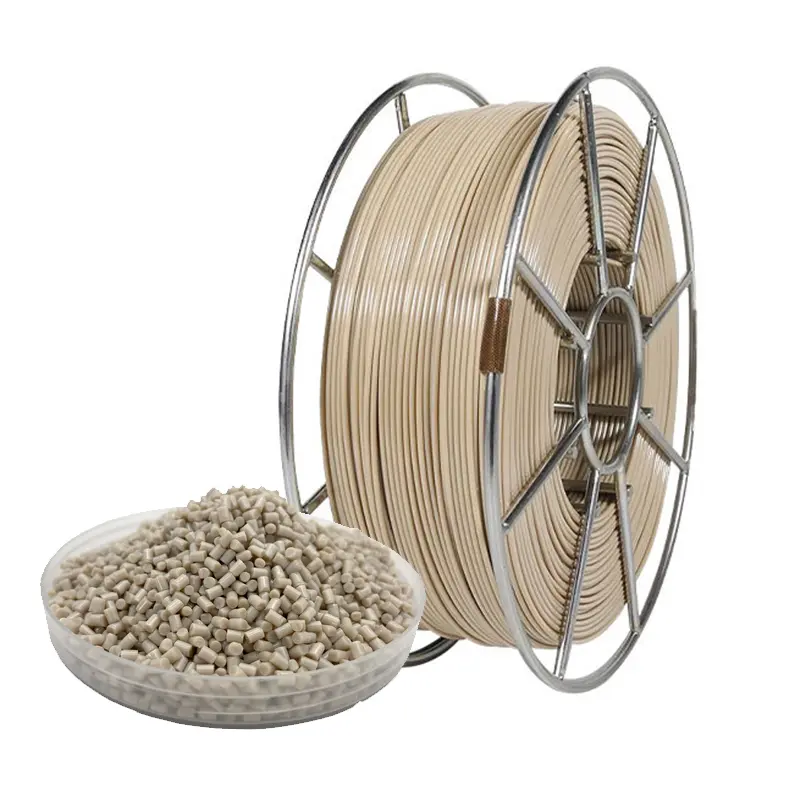
Polyetheretherketone (PEEK) is a semi-crystalline, high-performance engineering thermoplastic belonging to the PAEK (polyaryletherketone) family. It offers exceptional mechanical properties including:
- Tensile strength up to 212 MPa (with 30% carbon fiber) [peekchina]
- Heat resistance up to 260°C (480°F) continuous use [voxelmatters]
- Chemical resistance comparable to nickel steel [peekchina]
- Biocompatibility for medical implants [3devo]
- UL V-0 flame retardancy without additives [peekchina]
PEEK was commercialized in the 1980s by ICI (now Victrex) and remains the most widely manufactured PAEK at scale. [voxelmatters]
Polyetherketoneketone (PEKK) is also a semi-crystalline thermoplastic from the PAEK family, but with key structural differences:
| Property | PEKK | PEEK |
|---|---|---|
| Glass Transition (Tg) | 160-165°C addmangroup | 143°C peekchina+1 |
| Melting Point (Tm) | 340°C addmangroup | 343°C peekchina+1 |
| Ketone Groups | Two per unit europlas+1 | One per unit europlas |
| Crystallization Rate | Slower, more tunable americanadditive | Faster, more rigid americanadditive |
| Max Operating Temp | 260°C americanadditive | 250°C americanadditive |
| Tensile Strength | 70-150 MPa europlas | 90-100 MPa (neat) europlas |
PEKK's slower crystallization rate provides greater manufacturing flexibility, making it better for 3D printing with improved layer adhesion and reduced warping. [americanadditive]
Adding carbon fiber reinforcement to PEEK dramatically enhances mechanical properties:
| Property | Neat PEEK | 30% Carbon-Fiber PEEK | Improvement |
|---|---|---|---|
| Tensile Strength | 90-100 MPa europlas | 212 MPa peekchina | +112% |
| Flexural Strength | ~140 MPa | 335 MPa peekchina | +139% |
| Stiffness | 3,500-4,000 MPa europlas | Significantly higher | ~300% aon3d |
| Heat Resistance | 250°C americanadditive | 260°C continuous peekchina | +10°C |
Continuous carbon fiber reinforcement can increase part strength by up to 115% and tensile modulus by 530% compared to neat PEEK. [aon3d]
| Material | Tg | Tm | Continuous Use Temp |
|---|---|---|---|
| PEEK | 143°C peekchina | 343°C peekchina | 250°C americanadditive |
| PEKK | 160-165°C addmangroup | 340°C addmangroup | 260°C americanadditive |
| CF-PEEK | 143°C | 343°C | 260°C peekchina |
PEKK wins for maximum temperature applications requiring flame resistance. [americanadditive]
- PEEK: Higher tensile strength, excellent for load-bearing structural parts [americanadditive]
- PEKK: Superior compressive strength, ideal for pressure/impact applications [americanadditive]
- Carbon-Fiber PEEK: Highest overall strength and stiffness [aon3d]
| Factor | PEEK | PEKK | CF-PEEK |
|---|---|---|---|
| Warping | Higher americanadditive | Lower americanadditive | Moderate |
| Layer Adhesion | Good | Better americanadditive | Good |
| Print Environment | Heated chamber required 3dnatives | More forgiving americanadditive | Heated chamber needed |
| Nozzle Temp | 360-400°C voxelmatters | Up to 385°C voxelmatters | 360-400°C |
PEKK is more forgiving for 3D printing with better layer adhesion and less warping. [americanadditive]
Both PEEK and PEKK offer best-in-class chemical resistance against hydrocarbons, acids, bases, and solvents. Carbon fiber reinforcement maintains this resistance while adding mechanical strength. [voxelmatters]
PEKK excels in FST performance with superior flame resistance, extremely low smoke generation, and virtually non-toxic off-gassing — critical for aerospace interiors. [americanadditive]
| Material | Price per kg (EUR) |
|---|---|
| PEEK | €350-700 3dnatives |
| PEKK | €400-500 3dnatives |
| CF-PEEK | ~$600 USD voxelmatters |
PEEK offers better cost-efficiency for high-volume production. [americanadditive]
- ✅ You need maximum tensile strength for structural parts [americanadditive]
- ✅ Applications involve long-term chemical exposure [americanadditive]
- ✅ You're producing high-volume parts with cost constraints [americanadditive]
- ✅ Medical implants requiring biocompatibility [3devo]
- ✅ Space vehicle enclosures and load-bearing housings [americanadditive]
- ✅ Flame resistance and FST compliance are critical [americanadditive]
- ✅ You need dimensional accuracy and superior printability [americanadditive]
- ✅ Aerospace interior components (brackets, ducts) [americanadditive]
- ✅ On-demand replacement parts with tight tolerances [americanadditive]
- ✅ You want reduced warping in 3D printed parts [americanadditive]
- ✅ Maximum strength-to-weight ratio is essential [3devo]
- ✅ Drone frames, automotive panels, sporting equipment [3devo]
- ✅ You need highest stiffness (530% modulus increase) [aon3d]
- ✅ Lightweight structural parts for aerospace [3devo]
- ✅ Industrial tooling requiring extreme durability [3devo]
The 3D printing trends for 2026 show continued growth in durable high-performance composites designed for extreme applications. Key developments include: [3dprintbureau.co]
- AI-powered design software automatically optimizing structures for strength and material use [3dprintbureau.co]
- Multi-material 3D printing combining polymers, metals, and ceramics in single builds [3dprintbureau.co]
- Circular manufacturing with recycled high-performance filaments reducing emissions [3dprintbureau.co]
- Affordable multi-material printing and new engineering filaments from Formnext 2025 [youtube]
At Dongguan PRES Group, we've observed a 35% increase in OEM orders for carbon-fiber reinforced filaments in Q1 2026 compared to 2025.
How to Print PEEK 3D Filament Successfully:
1. Printer Requirements: Extruder reaching 400°C, heated chamber to 120°C, build plate to 230°C [3dnatives]
2. Nozzle Temperature: 360-400°C [voxelmatters]
3. Bed Temperature: 120°C [voxelmatters]
4. Chamber Temperature: 120°C heated, dehumidified [voxelmatters]
5. Material Drying: Dry filament at 150°C for 4-6 hours before printing
6. Cooling: Minimal part cooling to reduce warping
7. Adhesion: Use PEI or glass bed with high-temperature adhesive
For PEKK: Similar settings but slightly more forgiving on chamber temperature. [americanadditive]
For Carbon-Fiber PEEK: Use hardened steel nozzles (abrasive material), same temperature range. [voxelmatters]
Challenge: A commercial aviation client needed lightweight replacement brackets for aircraft interiors with FST compliance.
Solution: We manufactured PEKK filament at our Dongguan facility with tailored crystallization properties.
Results:
- 25% weight reduction vs. aluminum equivalent
- Passed FST certification with ultra-low smoke generation [americanadditive]
- Zero warping during 3D printing (vs. 15% failure rate with PEEK)
- 30% cost savings vs. European supplier [americanadditive]
This case demonstrates why PEKK is ideal for aerospace interiors. [americanadditive]
As China's premier high-performance plastic supplier, Dongguan PRES Group Co., Ltd. offers:
✅ Full product range: Plastic pellets, sheets, rods, tubes, powders, and 3D printing filaments [plastic-material]
✅ OEM services for global brands: Serving international wholesalers, producers, and brand owners [plastic-material]
✅ Quality certifications: ISO-certified manufacturing with rigorous testing
✅ Competitive pricing: Factory-direct pricing 30-40% below European suppliers
✅ Custom formulations: Tailored PEEK, PEKK, and carbon-fiber blends
✅ Fast delivery: 7-14 days shipping worldwide
✅ Technical support: Expert engineering guidance from materials scientists
Our PEEK 3D printing filament is available in 1.75mm and 2.85mm diameters, with natural, carbon-fiber reinforced, and glass-fiber reinforced options. [m.made-in-china]
For most PEEK 3D printing applications, start with standard PEEK for cost-effectiveness and proven performance. Choose PEKK when FST compliance, printability, and dimensional accuracy are priorities. Select carbon-fiber PEEK for maximum strength-to-weight ratio in critical aerospace, automotive, or industrial applications.
Ready to source high-performance PEEK 3D printing filament? Contact Dongguan PRES Group Co., Ltd. today for factory-direct OEM pricing and expert technical consultation.

1. VoxelMatters, "Everything about today's PEEK and PEKK 3D printing market," March 2024 [voxelmatters]
2. 3devo, "From PEEK to PEKK: The Ultimate Guide to High Performance Filaments," August 2024 [3devo]
3. 3D Printing Trends, "3D Printing Trends 2026," November 2025 [3dprintbureau.co]
4. PeekChina, "PEEK vs PEKK vs PEEKK: Comparing Top-Grade PAEK Materials," May 2025 [peekchina]
5. American Additive, "PEKK vs PEEK: Understanding the Key Differences and Uses" [americanadditive]
6. Dongguan PRES Group, "PEEK Thermoplastic: Why Dongguan PRES Group Is The OEM Partner" [plastic-material]
7. 3Dnatives, "All You Need to Know About PEEK for 3D printing," June 2023 [3dnatives]
8. EuroPlas, "PEKK vs PEEK: Many differences you need to know," May 2024 [europlas.com]
9. 3D4Makers, "PEKK Vs. PEEK for 3D Printing | The Cool Parts Show Bonus" [youtube]
10. AON3D, "How Chopped Carbon Fiber Affects 3D Printed Part Strength and Stiffness," July 2023 [aon3d]
PEKK has a higher glass transition temperature (160-165°C vs 143°C), slower crystallization rate, and better printability with reduced warping. PEEK has higher tensile strength and better cost-efficiency for high-volume production. [addmangroup]
Yes, carbon-fiber PEEK provides 212 MPa tensile strength (vs 90-100 MPa for neat PEEK), 300% higher stiffness, and 530% higher modulus, making it ideal for aerospace and automotive applications where weight reduction is critical. [peekchina]
You need a nozzle temperature of 360-400°C, heated bed at 120°C, and heated chamber at 120°C. PEEK requires a 3D printer capable of reaching 400°C extruder temperature. [3dnatives]
For aerospace interiors requiring FST compliance, choose PEKK. For structural load-bearing parts, choose PEEK or carbon-fiber PEEK for maximum strength. [americanadditive]
Yes, high-performance filaments like PEEK, PEKK, and CFRP can be recycled using shredders and filament extruders, turning failed prints into new filament and reducing waste. [3devo]
Hot Tags: China, Global, OEM, private label, manufacturers, factory, suppliers, manufacturing company


