


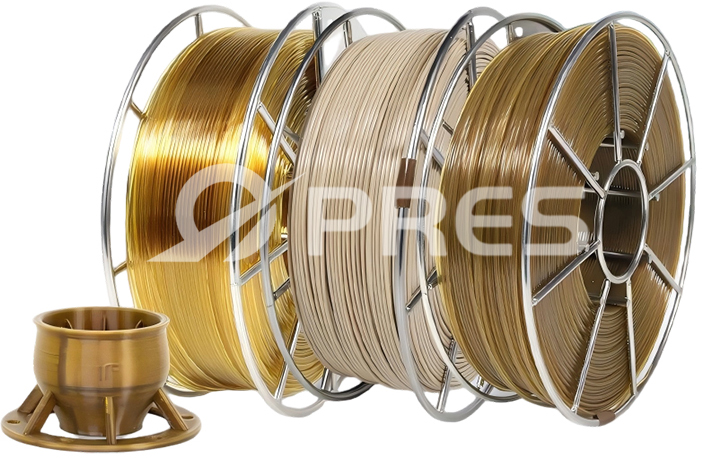
Which 3D printing filament has strongest Tensile & Flexural Strength?
3D printing filaments Tensile & Flexural Strength (values per the table below):
Tensile: PEEK CF10 (140 MPa) > PEI 1010 (110 MPa) > PEEK GF10 (124 MPa) > PPS CF10 (100 MPa) ≈ Unfilled PEEK (100 MPa) > PEI 9085 (88 MPa) > PPS Pure Resin (80 MPa) > PPSU (70 MPa).
Flexural: PEEK CF10 (260 MPa) > Unfilled PEEK (170 MPa) > PEI 1010 (160 MPa) > PPS CF10 (155 MPa) > PEEK GF10 (153 MPa) > PPS Pure Resin (140 MPa) > PEI 9085 (129 MPa) > PPSU (91 MPa).
PEEK CF10 has the highest Tensile Strength 140 MPa and flexural strength 260 MPa.
PEI 1010 follows closely with 110 MPa tensile and 160 MPa flexural strength, the strongest among unreinforced grades.
PPS CF10 shows 100 MPa tensile and 155 MPa flexural per the confirmed data table.
| Material | PEEK CF10 | PEI 1010 | PEEK GF10 | Unfilled PEEK | PPS CF10 | PEI 9085 | PPS | PPSU |
| Tensile Strength | 140MPa | 110MPa | 124Mpa | 100MPa | 100MPa | 88MPa | 80MPa | 70MPa |
| Flexural strength | 260MPa | 160MPa | 153MPa | 170MPa | 155MPa | 129MPa | 140MPa | 91MPa |

Which grades 3D printing filament has higher Stiffness (Modulus)?
Ranking: PEEK CF10 > PPS CF10 > PEEK GF10 > Unfilled PEEK > UNFILLED PPS > PEI 1010 > PEI 9085 > PPSU
| Material | PEEK CF10 | PPS CF10 | PEEK GF10 | Unfilled PEEK | Unfilled PPS | PEI 1010 | PEI 9085 | PPSU |
| Flexural modulus | 10300MPa | 5600MPa | 5310MPa | 4200MPa | 3400Mpa | 3300MPa | 2850MPa | 2410Mpa |
Which grades 3D printing filament has higher Impact Toughness?
Ranking: PPSU > PEI 1010 > PEI 9085 > PEEK CF10 > PPS CF10
PPSU is the toughest of the four-elongation at break 60-120%, and it withstands over 1,000 steam-sterilization cycles with no significant degradation, making PPSU pure resin the uncontested choice for medical, food, and infant-care scenarios requiring repeated sterilization plus drop resistance.
PEI 1010 elongation 60%, PEI 9085 70%-both represent "high-elongation" toughness.
PEEK CF10 retains good toughness but carbon fiber drops elongation to only 2.5%.
Compressive Load-Bearing & High-Temperature Strength Retention
Ranking: PEEK CF10 > PEEK GF10 > PEEK Pure Resin > PPS CF10 > PEI 1010 > PPSU > PEI 9085
Compressive strength and hot-strength retention are PEEK's heritage. Pure PEEK compressive strength reaches 125 MPa and retains ~70% room-temperature strength at 250°C. PEEK CF10 extends this to continuous use from -196°C to 250°C with short-term peaks at 300°C. PPS CF10 operates continuously at 220°C, the runner-up in high-temperature load capacity.
PEI 1010 (Tg 217°C) and PEI 9085 (Tg 186°C) are amorphous; modulus decays faster above Tg than semi-crystalline PEEK/PPS. PPSU (Tg ~220°C, short-term >200°C, long-term 180°C) shows moderate compression/hot performance.
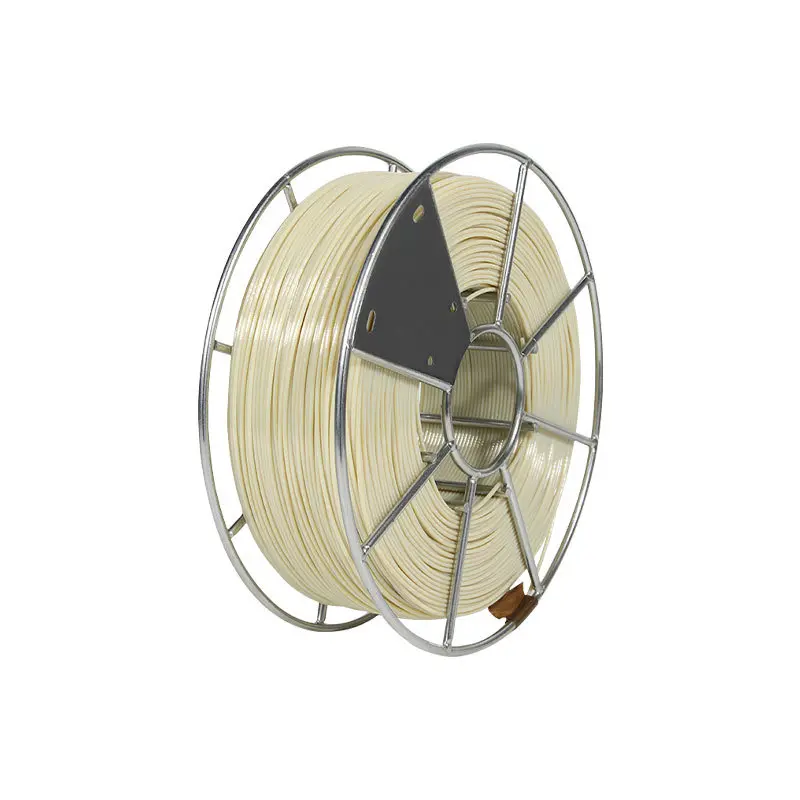
ULTEM 9085 3D printing filaments

ULTEM 1010 3D printing filaments
Which 3D printing filaments has best Thermal Resistance (HDT & Continuous Use Temperature)?
HDT Ranking @1.8MPa (from table): PEEK CF10 (288°C) > PEEK GF10 (210°C) > PPSU (207°C) > PEI 1010 (190°C) > PEI 9085 (153°C) > PEEK Pure Resin (152°C) > PPS CF10 (105°C) > PPS Pure Resin (95°C)
CUT Ranking: PEEK CF10 = PEEK Pure Resin (260°C) > PEEK GF10 (250°C) > PPS Pure Resin (200-240°C) > PPS CF10 (220°C) > PEI 1010 (180-200°C) ≈ PPSU (180°C) > PEI 9085 (170°C)
| Grade | HDT (°C) | Continuous Use Temp (°C) |
|---|---|---|
| PEEK CF10 | 288(1.8MPa) | 260 |
| PEEK Pure Resin | 152 (1.8MPa) | 260 |
| PPS CF10 | 105(1.8MPa) | 220 |
| PPSU | 207(1.8MPa) | 180 |
| PEI 1010 | 190(1.8MPa)-209(0.45MPa) | 180-200 |
| PEI 9085 | 153(1.82MPa) | 170 |
| PEEK GF10 | 210(1.8MPa) | 250 |
| PPS Pure Resin | 95(1.8MPa)-160(0.45MPa) | 200-240 (theoretical) |
PEEK CF10 leads with HDT 288°C, the only grade capable of long-term load at 250°C. PEEK GF10 and PPSU form the high-HDT tier after CF10, though pure PEEK's 152°C HDT under 1.8MPa load warns that rigidity drops under hot load without reinforcement or annealing.

Best of the Best - By Application
Overall Strength & Temperature King → PEEK CF10: 10% CF tops all four dimensions. Nozzle 380-420°C, chamber >80°C, hardened steel nozzle. Applications: aerospace brackets, semiconductor fixtures, non-implant medical, gears.
Aerospace-Certified Balanced Choice → PEI 9085: FAR 25.853 FST pre-certified. Nozzle 350-380°C, chamber 130-160°C. Aircraft interiors, ducts, seat brackets.
Best High-Temp PEI (No FST) → PEI 1010: HDT 190-209°C, Tg 217°C, tensile 110 MPa, FDA & NSF 51, steam-sterilizable. Surgical trays, lab ware.
Toughness & Sterilization Expert → PPSU Pure Resin: >1000 sterilization cycles, 60-120% elongation. Nozzle 340-370°C, chamber 140-160°C. Baby bottles, surgical handles, chemical pump parts.
Rigidity/Cost/Chemical Dark Horse → PPS CF10: Stiffness 5600 MPa, HDT 105°C@1.8MPa, V-0, chemical resistant, ~1/4-1/3 cost of PEEK CF10. Printable without heated chamber (nozzle 310-330°C). Warning: severe anisotropy, brittle-load must lie in XY plane.
Quick-Reference Selection Checklist
250°C long-term high-load parts → PEEK CF10 (only choice)
200-230°C high-stiffness, budget-sensitive → PPS CF10 (best value)
180-200°C aircraft interior, needs FST → PEI 9085 (certification lock)
180-200°C food/medical sterilization → PEI 1010 (FDA + high temp)
Repeated steam sterilization + impact → PPSU Pure Resin (only tough+sterile)
High-temperature corrosive environment → PEEK CF10 or PPS CF10 (top chemical resistance)
PEEK-level temp but no heated chamber → PPS CF10 (only feasible)
PEEK GF10 positioning → Stiffness between pure PEEK and CF10, cheaper than CF10, for high rigidity without extreme strength.
Final Selection Advice
"Most outstanding" depends on failure mode. Creep → PEEK CF10; drop impact → PPSU; cost overrun → PPS CF10. These four material families form the current strongest FFF filament tier; there is no absolute "best," only "most suitable."
Print process dictates success more than material. PEEK CF10 needs industrial printer; PPS CF10 tolerates room-temperature chamber-much lower barrier.
Reinforcement logic differs. PEEK GF10 trades strength for modulus; PPS CF10 boosts strength, modulus, and temperature together-understand the direction.
Data variance warning. Values are typical; PPS CF10 especially varies (100 MPa tensile per confirmed table). Always request full TDS and print test coupons before production.


