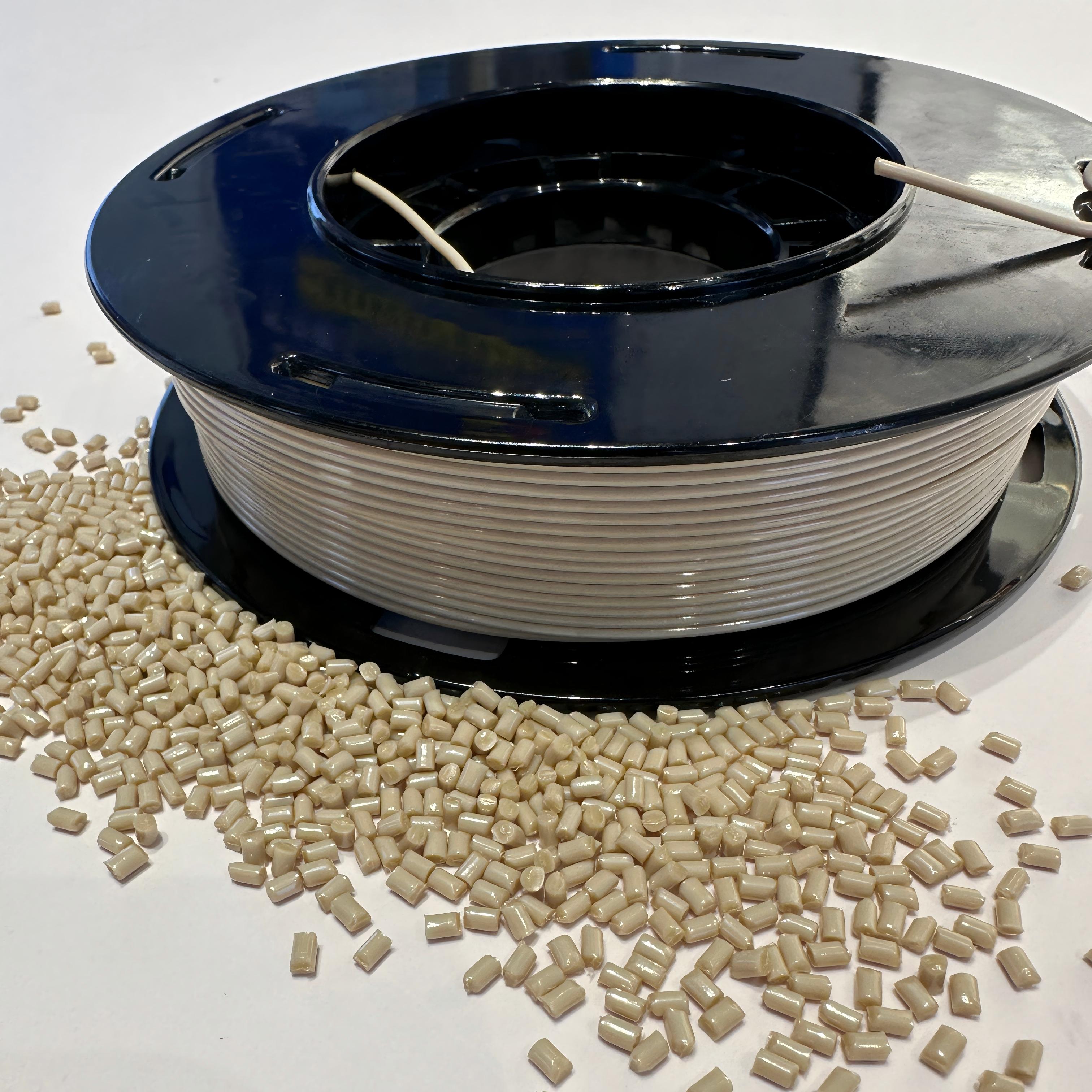
|


| Material: | |
|---|---|
| diameter: | |
| weight: | |
| length: | |
| Quantity: | |
PEEK-3D
PRES
|How to print PEEK material?
PEEK has high melting point,so it need high processing Temperature to print smooth,it is important to keep the nozzle over 390°C.
| Material | drying Temperature | drying time | nozzle Temperature | Platform Temperature | Chamber temperature: | printing speed |
| PEEK | 150°C | 3H | 390-430°C | 100-140°C | 133-162°C | 15-50mm/s |
●PEEK material after 3D printing ,it needs Annealing process to Eliminate internal stress and enhance crystallinity!After annealing can make the PEEK printed parts has better heat resistance and ccorrosion resistance
| Item | Unit | Value |
Tensile strength | MPa | 100 |
Elongation at break | % | 45 |
density | g/cm3 | 1.3 |
Bending modulus | GPa | 4.1 |
Glass transition temperature | ℃ | 143 |
| Heat distortion temperature (℃) | ℃ | 152 |
Fine layer lines and a smooth surface finish—achieving an appearance close to injection-molded parts with virtually no post-processing required.
Dimensional accuracy stable within ±0.1mm; parts won't deform or crack, and can go straight to assembly verification or final installation.
Dense interlayer bonding with zero pores or silver streaks; mechanical properties at 260°C are fully aligned with the raw material's nominal values—enabling PEEK 3D printing to truly leap from "barely doable" to "reliable, trustworthy, and a direct replacement for machining."