Views: 218 Author: PRES Publish Time: 2026-07-23 Origin: Site


Content Menu
● 1. Superior High-Temperature Resistance
● 2. Exceptional Chemical and Hydrolytic Stability
● 3. Precision Dimensional Stability
● 4. High Strength and Resistance to Creep
● 5. Inherent Flame Retardancy and Electrical Insulation
● 6. Design Flexibility: High-Performance Injection Molding
● Key Applications in Engine Assembly
● Expert Insight: When to Choose PPS
● Frequently Asked Questions (FAQ)
In modern automotive engineering, the demand for components that can withstand extreme environments—characterized by high temperatures, corrosive chemicals, and constant mechanical vibration—has never been higher. As vehicle systems become more compact and efficient, traditional materials are often pushed to their limits. Polyphenylene Sulfide (PPS) has emerged as a cornerstone engineering thermoplastic, bridging the gap between standard engineering plastics and high-end, costly polymers like PEEK.
For engine assembly systems, selecting the right material is not just about performance; it is about ensuring long-term reliability in the most hostile conditions under the hood. As professional engineers and manufacturing partners, we at PRES specialize in high-performance materials and components, providing not just the raw materials, but also the CNC machining and injection molding expertise required to bring your designs to life.
Below, we explore the six core advantages of PPS that make it the industry-preferred choice for next-generation engine assembly systems.

The automotive engine compartment is a thermal battlefield. Components must withstand long-term operating temperatures of 150-200°C and temporary spikes up to 260°C. Unlike common engineering plastics like Nylon (PA6/PA66) or PBT, which can soften, lose structural integrity, or undergo long-term thermal degradation in these conditions, PPS remains rigid and stable [1, 2, 7, 10]. Its inherent thermal stability allows it to maintain mechanical properties without deforming, ensuring critical assemblies remain secure during the vehicle's entire operational lifespan [2, 5, 8].
Modern engines utilize a variety of aggressive fluids, including fuels, oils, coolants, and electrolytes. Materials that swell, hydrolyze (degrade in the presence of water/steam), or leach chemicals can lead to pipe blockages, sensor failures, or catastrophic leaks [5, 11]. PPS is virtually inert to most automotive chemicals and solvents at temperatures below 200°C [1, 6, 8, 11]. It does not swell or hydrolyze, outperforming metal components that are prone to corrosion and rust in similar wet or chemically aggressive environments [1, 7].
For engine assemblies, tight tolerances are non-negotiable. PPS exhibits exceptionally low moisture absorption and a low coefficient of linear thermal expansion [6, 11]. While other plastics may expand or contract significantly due to temperature shifts or moisture saturation—leading to alignment issues or loss of sealing pressure—PPS maintains its shape [5, 11]. This dimensional precision guarantees that precision-engineered components, such as valve housings and sensor casings, maintain their fit and seal under severe thermal cycling and vibration [2, 5, 8].
As manufacturers strive to reduce vehicle weight, metal-to-plastic conversion has become a primary design strategy. PPS provides the mechanical strength required for these structural replacements [7, 8]. A critical advantage of PPS is its superior resistance to creep—the tendency of a solid material to slowly move or deform permanently under the influence of mechanical stresses [5, 9, 11]. In engine systems subject to continuous pressure and vibration, PPS components remain tight and secure, resisting the loosening that often compromises long-term assembly integrity [2, 5, 8].
Modern vehicles are increasingly electrified, with ignition systems, advanced sensors, and high-voltage connections requiring materials that prevent short circuits and fire hazards [2, 7]. PPS is naturally flame retardant, achieving UL94 V-0 ratings without the need for additional halogenated flame retardants [1, 6, 11]. Its excellent dielectric strength and stable electrical insulation properties across wide temperature and frequency ranges make it the ideal material for coil bobbins, sensor housings, and high-pressure connectors that must perform flawlessly in safety-critical applications [1, 5, 8, 11].
PPS allows for the manufacturing of complex, integrated geometries in a single injection molding process, significantly reducing the need for costly secondary machining or multi-part assembly [2, 7, 8]. This ability to "part consolidate" not only reduces production time and costs but also improves the overall reliability of the system by minimizing potential failure points [8, 11]. Whether you require high-volume injection molding or specialized CNC precision machining, PPS's processability makes it a highly versatile tool for modern manufacturing [1, 5, 7, 8].
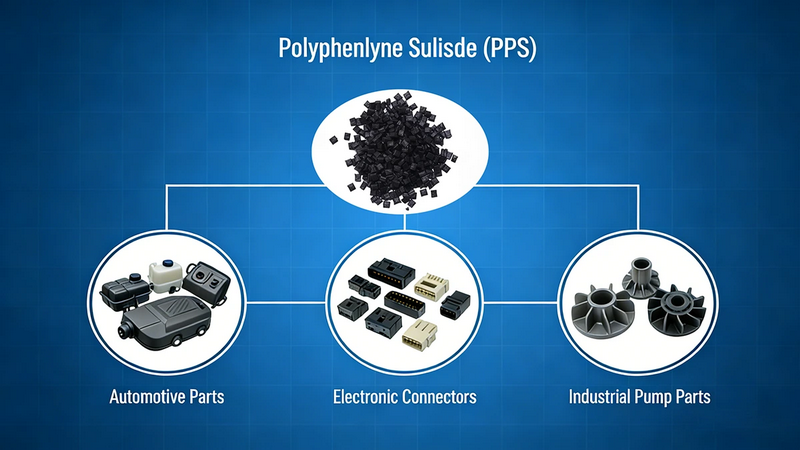
PPS is the material of choice for components residing in the engine compartment's "hot zone":
- Fluid Systems: Cooling water valves, pump housings, and tube connectors [2, 7, 8].
- Electrical/Electronic Systems: Ignition coil bobbins, sensor housings, and high-voltage connectors [1, 5, 7, 8].
- Structural Powertrain: Turbocharger components, mounting brackets, and air intake housings [5, 7, 8, 11].
From an engineering perspective, PPS occupies a strategic position in the material hierarchy. While PEEK offers higher ultimate performance, it comes at a significantly higher price point. For most under-the-hood applications, PPS provides a superior cost-performance balance, offering the thermal and chemical endurance needed without the "over-engineering" costs of ultra-high-end polymers. When transitioning from metal, or upgrading from commodity plastics, PPS is often the most pragmatic and reliable solution to ensure that your engine assembly meets modern performance, weight, and reliability standards.
1. Why is PPS better than Nylon (PA66) for engine parts?
While Nylon is strong, it absorbs moisture, leading to dimensional changes and loss of strength in humid or wet conditions. PPS has near-zero moisture absorption and maintains superior strength and thermal stability at 200°C+ [2, 5, 11].
2. Can PPS withstand long-term exposure to hot oil and coolant?
Yes. PPS is exceptionally inert and resistant to hydrolysis. It does not swell, degrade, or leak when exposed to typical automotive fuels, hot oils, and cooling fluids over long periods [1, 5, 11].
3. Does PPS require additives to be flame retardant?
No. PPS is inherently flame retardant and can achieve a UL94 V-0 rating without adding external flame retardant agents, ensuring cleaner, more consistent material properties [1, 5, 8].
4. Is PPS suitable for precision parts with tight tolerances?
Absolutely. Its low mold shrinkage, low moisture absorption, and low coefficient of thermal expansion make it ideal for high-precision components that must maintain their shape under temperature cycling [2, 5, 11].
5. How does PPS compare to PEEK in cost and performance?
PEEK is more ductile and heat-resistant than PPS, but PPS is significantly more cost-effective for most automotive applications, offering excellent chemical resistance and mechanical strength that meet or exceed industry requirements for under-hood use [2, 5, 8].
[1] Beeplastic. "PPS Plastic: Innovative Uses in Diverse Applications." *Beeplastic Blog*. [https://www.beeplastic.com/blogs/plastic-insights/exploring-the-frontier-innovative-uses-of-pps-plastic-in-diverse-modern-industries]
[2] Rapid Protos. "PPS Plastic: Properties, Grades, Processing & Applications." *Rapid Protos*. [https://www.rapid-protos.com/what-is-pps-plastic]
[3] Plastic Molded Concepts. "Plastic Injection Molding Automotive Case Study." *PMC Plastics*. [https://pmcplastics.com/resources/case-studies/plastic-injection-molding-automotive-case-study]
[4] Syensqo. "Ryton® PPS Polyphenylene Sulfide." *Syensqo*. [https://syensqo.com/en/brands/ryton-pps]
[5] Ensinger. "PPS Plastic | Tecatron." *Ensinger Plastics*. [https://www.ensingerplastics.com/en/thermoplastic-materials/pps-plastic]
[6] Europlas. "Defining PPS Plastic and its Applications." *Europlas*. [https://europlas.com.vn/en-US/blog-1/defining-pps-plastic-and-its-applications-you-need-to-know]
[7] Xiamen Keyuan Plastic. "PPS Raw Material in Automotive Applications." *Keyuan Plastics*. [http://m.ky-plastics.com/pc-abs-alloy/pps-raw-material-in-automotive-applications.html]
[8] FastParts. "PPS: Thermal and Dimensional Stability, Chemical Resistance." *FastParts*. [https://www.fastparts.it/en/component/content/article/pps-thermal-and-dimensional-stability-chemical-resistance]
[9] Aprios. "Polyphenylene Sulfide (PPS): Resin for Extreme Conditions." *Aprios*. [https://www.aprios.com/insights/polyphenylene-sulfide-pps-the-ultimate-resin-for-extreme-conditions]
[10] Polymaker. "PPS | Material Wiki." *Polymaker Wiki*. [https://wiki.polymaker.com/the-basics/3d-printing-materials/pps]
[11] MachiningPEEK. "The Application Of Various Plastics (PPS/PEEK/PA66/PP, etc.) On Gaskets." *MachiningPEEK*. [https://machiningpeek.com/the-application-of-various-plastics-pps-peek-pa66-pp-etc-on-gaskets]