Views: 0 Author: Site Editor Publish Time: 2026-05-14 Origin: Site


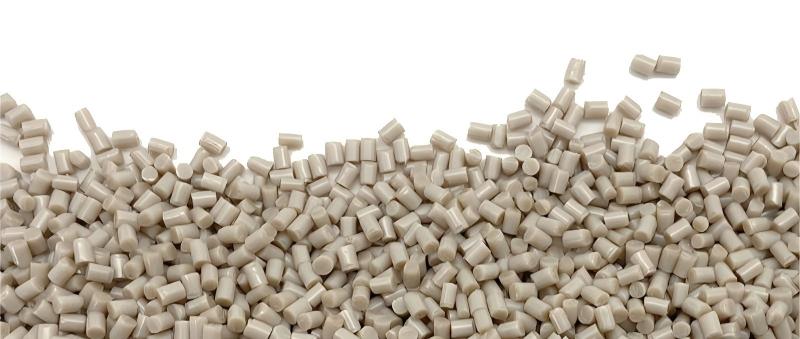
PEEK material injection molding and machining may cause warping. However, today we mainly discuss how to solve the warping problem during PEEK injection molding.
When warping happens, some customers will say :
"Is there any quality issue with your material?" But I will always tell them that is normal and also provide them with the solutions.
So I also want you to know how to fix the PEEK warping:firstly,we need to set the suitable mold temperature.secondly,we should provide enough cooling time for PEEK material, and I will teach you how to calculate the cooling time in the following text.
Content Menu
● Characteristics of PEEK Material
● Why does PEEK material warp?
>> 1.Temperature difference between the inside and outside.
>> Another reason is that the stress has not been fully released.
● So, how to solve the warping of PEEK material?
>> Firstly, the setting of the PEEK mold temperature
>> The cooling time for PEEK material is also very important.
>>> How to set the cooling time?
PEEK material is a semi-crystalline material. When the molten PEEK material gradually cools in the mold, it begins to crystallize, and during this process, PEEK material will start shrinkage. The shrinkage rate of PEEK material varies in different flow directions, and the shrinkage rate also differs among different types of PEEK materials.
The shrinkage rate of pure PEEK resin material is relatively high, while the shrinkage rate of reinforced glass fiber-filled PEEK and carbon fiber-filled PEEK materials is smaller.
| Material | PEEK resin | PEEK GF30 | PEEK CA30 |
| Mould Shrinkage Along Flow | 1% | 0.3% | 0.1% |
| Mould Shrinkage Across Flow | 1.3% | 0.8% | 0.5% |
The thin PEEK parts in the mold are closer to the surface of the cavity and are exposed to the cold mold wall first, rapidly cooling and crystallizing; while the interior melt cools slowly and crystallizes for a longer time.
This results in different crystallization degrees on the inner and outer layers of the plastic part - the outer layer has a lower crystallization degree and smaller shrinkage, while the inner layer has a higher crystallization degree and larger shrinkage, which causes internal stress in the PEEK part and the part naturally warps.
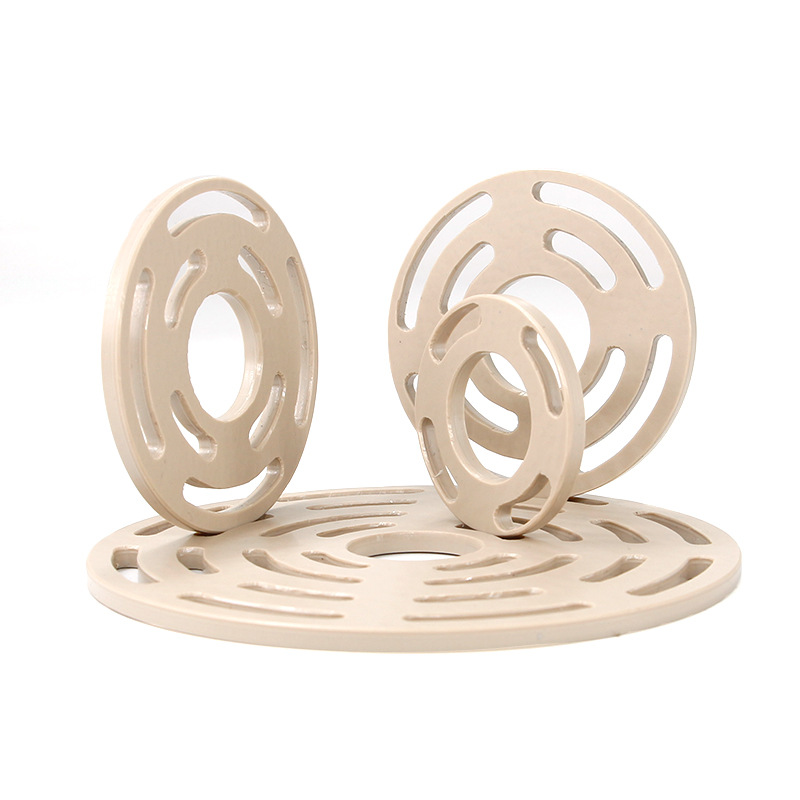
Last year, I measured a 1.2mm thick PEEK grille component. When the surface temperature dropped to 150℃, the internal temperature was still 280℃. Such a large temperature difference easily causes warping.
The second reason is the uneven cooling of the mold. When designing PEEK injection molds, we consider the layout of the cooling channels. In the mold, some parts are closer to the cooling channels and cool faster, while some areas are farther away from the cooling channels and cool more slowly. When the cooling speed of the PEEK part is different, the parts that cool faster will warp towards the parts that cool slower.
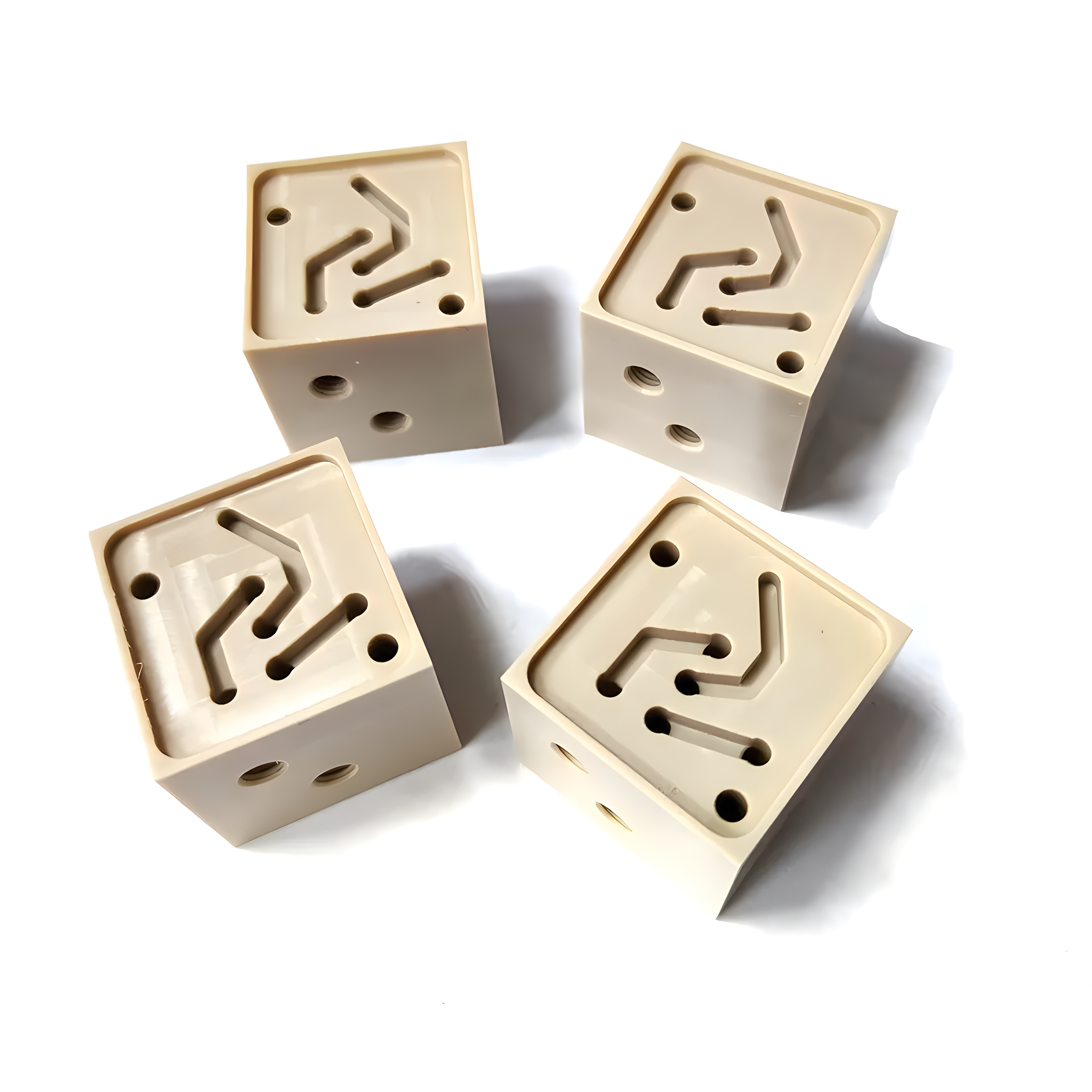
When PEEK material is injected, the molten material flows rapidly in the narrow mold cavity, and the molecular chains are forcibly stretched. If the cooling temperature drops too quickly, these stretching stresses cannot be released in time and will remain in the plastic part. When the PEEK part is released from the mold, the stress will be released, causing warping. One of my customer once reduced the cooling time from 20 seconds to 12 seconds to improve efficiency, but the warping became more severe(He was uesing carbon fiber reinforced PEEK,the max thickness of the PEEK parts is 2.1mm ).
Wtiter opinion:
"Therefore, I would like to suggest you that when producing thin PEEK parts, don't be hurry. Ensure that there is enough time for PEEK to crystallize and release stress. The quality is more important than the quantity".
Rio Liang |PEEK Manufacturer
Mold surface temperature: 10-20℃ higher than the glass transition temperature of PEEK (143℃), because PEEK material no longer crystallizes below the glass transition temperature. Therefore, the mold temperature is generally set at 150-160℃ to allow the plastic part to crystallize slowly and avoid rapid cooling that causes stress;
Middle layer temperature of the mold: 20-30℃ lower than the surface of the cavity. Set it at 120-140℃ to guide the heat to slowly transfer outward from the interior of the molded part.
Backside temperature of the mold: 30-40℃ lower than the middle layer. Set it to 80-110℃ to ensure that the heat can be quickly dissipated from the mold.
In this way, the temperature gradient from the outside to the inside of the plastic part can be controlled within 30-50℃, and the warping can be significantly improved.
Many customers, when manufacturing PEEK components, aim to enhance production efficiency by shortening the cooling time of the PEEK material. However, I do not recommend this approach, especially when producing PEEK parts with a thin thickness. The thin PEEK components lose heat quickly. However, the PEEK material requires sufficient time to fully crystallize. If the cooling process is too rapid, not only will warping occur, but the strength of the product will also decrease.
Wall thickness (mm) × 8 to 10 seconds
A product with a thickness of 1mm requires a cooling time of 8 to 10 seconds.
As we mentioned, when the temperature of PEEK material is below its Tg, it no longer crystallizes. At this point, PEEK material will not shrinkage again. Therefore, at temperatures below 140°C, it is time to release the PEEK material.