
Views: 257 Author: Dongguan PRES Publish Time: 2026-08-18 Origin: Site


Content Menu
● Why PEEK Rings Resist Wear Under High Pressure
>> Core advantages of PEEK seal rings
● How High Pressure Changes Seal Wear
>> The pressure–velocity challenge
>> Dynamic motion types that affect PEEK wear
● Material Grade Matters More Than Many Buyers Expect
>> Common PEEK options for dynamic seals
>> Expert insight: avoid a "lowest friction" decision
● Ring Design Factors That Determine Service Life
>> 2. Specify the mating-surface finish
>> 3. Prevent heat accumulation
>> 4. Design for real contamination
● PEEK vs PTFE for High-Pressure Dynamic Seals
● Practical Validation Plan for OEM Seal Projects
>> Step-by-step qualification process
● What Customers Commonly Value in PEEK Ring Projects
● Choose PRES for Custom PEEK Seal Rings
● FAQ
>> 1. Are PEEK rings suitable for high-pressure dynamic seals?
>> 2. What causes PEEK seal rings to wear prematurely?
>> 3. Is filled PEEK better than natural PEEK for seal rings?
>> 4. Can PEEK replace PTFE in a dynamic sealing system?
>> 5. What information should I provide for a custom PEEK sealing-ring quote?
>> 6. Can PRES provide OEM PEEK seal rings for overseas brands?
At Dongguan PRES Group Co., Ltd., we manufacture high-performance PEEK materials and custom PEEK components for global brands, wholesalers, and industrial manufacturers. For demanding fluid-power, compressor, pump, valve, and energy applications, the wear resistance of PEEK rings in high-pressure dynamic seals is one of the most important factors affecting leakage control, service life, maintenance cost, and equipment uptime.
PEEK sealing rings are not a universal replacement for every elastomer or PTFE seal. However, when a dynamic sealing system faces high pressure, elevated temperature, aggressive media, repeated motion, or extrusion risk, properly engineered PEEK rings can provide a major durability advantage. The key is not simply choosing "PEEK"; it is selecting the right grade, ring geometry, mating surface, tolerances, and operating window.

PEEK, or polyether ether ketone, is a semi-crystalline high-performance thermoplastic known for its mechanical strength, thermal stability, chemical resistance, and dimensional consistency. In high-pressure dynamic seals, these characteristics help the ring survive conditions that can rapidly deform, extrude, crack, or wear down conventional polymer seals.
For dynamic sealing, wear is not only material loss. It is the combined result of contact pressure, sliding speed, lubrication, temperature, surface finish, contamination, seal geometry, and pressure cycling. A sealing ring can have excellent laboratory wear data but still fail early if the gland design creates excessive interference or if the mating surface is too rough.
- High compressive strength helps the ring resist deformation under load.
- Strong creep resistance supports dimensional stability during long pressure dwell periods.
- Good wear resistance helps reduce material loss during reciprocating or rotary movement.
- High-temperature capability makes PEEK suitable for applications where frictional heat and process temperature exceed the limits of many general engineering plastics.
- Chemical resistance supports use in many oils, fuels, solvents, process fluids, and corrosive service environments.
- Low moisture absorption helps maintain dimensions more consistently than moisture-sensitive polymers.
- Machinability enables custom cross-sections, split rings, backup rings, guide rings, piston rings, valve seats, and sealing profiles.
PEEK can be used continuously at temperatures up to approximately 250°C in appropriate applications, although actual seal performance must always be confirmed against pressure, chemical medium, motion type, and system design. PEEK's glass-transition temperature is commonly around 143°C and its melting point is approximately 343°C, helping explain why it retains useful mechanical performance at temperatures where many plastics soften or lose stiffness.
High pressure raises contact stress between the PEEK ring and its mating surface. It also increases the risk of extrusion into clearance gaps. In a dynamic system, these forces interact with motion and heat generation, creating conditions that can accelerate wear if the design is not balanced.
Engineers commonly assess dynamic polymer sealing through a pressure–velocity, or PV, perspective:
Where:
PPP is the contact pressure.
VVV is sliding velocity.
A seal may tolerate high pressure at low speed or high speed at low pressure, but the combination of both can generate excessive frictional heat. This can change the polymer's surface behavior, increase adhesion, damage the counterface, and reduce sealing life.
PEEK is valuable because it combines relatively high stiffness with useful thermal resistance. This helps it remain structurally stable under high loads where softer materials may cold-flow or extrude. Industry guidance has reported PEEK seals operating at pressures up to 30 ksi, or about 207 MPa, but that figure should never be used as a general design rating without validating the specific seal profile, gap, medium, temperature, and cycling conditions.
| Motion type | Typical wear mechanism | Design priority |
|---|---|---|
| Reciprocating | Sliding abrasion, stick-slip, edge wear | Surface finish, lubrication, interference |
| Rotary | Heat buildup, continuous friction, runout | Shaft concentricity, PV control, cooling |
| Oscillating | Fretting, lubricant starvation | Micro-motion control, anti-fretting grade |
| Pressure cycling | Fatigue, extrusion, creep recovery | Gap control, support ring design |
| Dry running | Adhesion, transfer-film instability | Tribological compound selection |
One of the most common mistakes in high-pressure seal design is treating all PEEK materials as equivalent. Natural PEEK is not automatically the best choice for a dynamic wear application. A filled PEEK compound may provide better friction behavior, better wear resistance, or improved resistance to deformation, depending on the system.
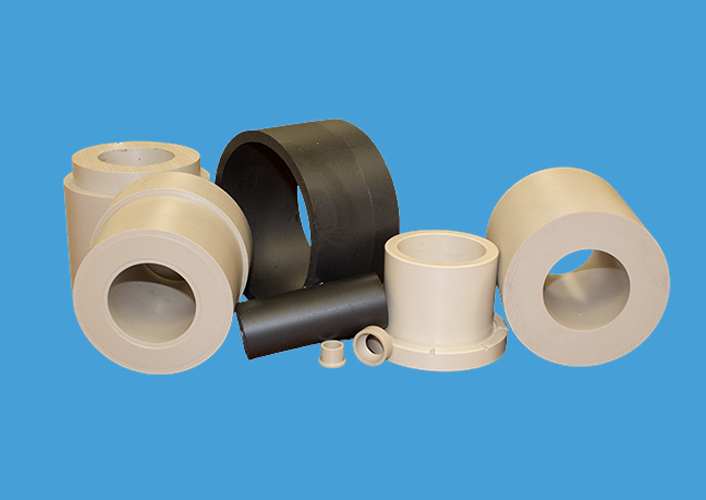
At PRES, we support OEM development with PEEK raw materials, sheets, rods, tubes, powders, pellets, and customized machined parts. This allows engineering teams to select material and process routes based on the real operating environment rather than selecting a standard catalog part.
| PEEK material type | Typical strength | Wear behavior | Best-fit applications |
|---|---|---|---|
| Natural PEEK | High | Good, but application-dependent | Chemical service, low-contamination systems, structural seal supports |
| Carbon-fiber-reinforced PEEK | Higher stiffness | Excellent in many wear applications | High-load guide rings, backup rings, bearing-style components |
| Glass-fiber-reinforced PEEK | High stiffness | Improved strength; may affect mating surfaces | High-pressure structural support applications |
| PTFE-filled PEEK | Lower friction | Strong potential for sliding seals | Reciprocating and rotary dynamic sealing |
| Bearing-grade PEEK | Balanced friction and wear properties | Often optimized for tribology | Pumps, compressors, bushings, wear rings, seal rings |
Carbon-reinforced PEEK is widely recognized for strong wear performance, while unreinforced PEEK is generally described as offering good wear resistance. Compounds containing PTFE, graphite, and carbon fiber are often used as bearing-grade PEEK because the formulation can reduce friction while improving wear performance under demanding sliding conditions.
The lowest-friction material is not always the longest-lasting seal material. A very low-friction compound may have lower load capacity, while an extremely stiff reinforced material may be more abrasive against a soft counterface.
The right decision requires balancing:
- Wear rate of the PEEK ring
- Wear of the shaft, rod, bore, or mating ring
- Leakage tolerance
- Pressure and clearance gap
- Dry-running or lubrication conditions
- Permitted particle generation
- Chemical compatibility
- Manufacturing tolerances
For example, a carbon-filled PEEK guide ring may be ideal for high-load support, while a PTFE-filled PEEK sealing element may better control friction on a polished reciprocating rod. In many high-pressure designs, the strongest solution is a combined seal system, not a single material ring.
The wear resistance of PEEK rings in high-pressure dynamic seals depends as much on geometry and installation as on polymer selection. A high-quality PEEK compound cannot compensate for excessive clearance, a damaged bore, poor shaft finish, or an incorrectly machined groove.
Pressure forces a polymer seal toward any available clearance gap. If the gap is too large, the PEEK ring can extrude, shear, or develop a feathered edge. Wear then accelerates quickly.
Designers should evaluate:
- Maximum diametral clearance at pressure.
- Thermal expansion of metal hardware and polymer components.
- Out-of-roundness and concentricity.
- Pressure spikes rather than only nominal pressure.
- Whether a backup ring or anti-extrusion ring is required.
PEEK backup rings are commonly used to support softer primary seals and prevent extrusion in high-pressure environments.
The counterface must be smooth enough to limit abrasive wear but not so polished that lubrication retention becomes poor. The ideal finish varies by medium, speed, compound, and seal profile.
A practical engineering process should include:
1. Define the shaft or bore material and hardness.
2. Specify surface roughness and waviness limits.
3. Check for spiral machining marks that can pump fluid past the seal.
4. Verify that coatings, plating, and thermal spray layers are compatible with the selected PEEK grade.
5. Inspect real production parts, not only nominal drawings.
Dynamic friction creates heat at the sealing interface. If heat cannot escape, local temperatures may be far higher than the measured fluid temperature. This matters especially in dry-running compressors, high-speed rotary equipment, and tightly packed reciprocating seals.
Ways to reduce thermal stress include:
- Selecting a lower-friction PEEK compound.
- Reducing unnecessary seal interference.
- Improving lubrication or fluid cooling.
- Using multiple sealing stages when appropriate.
- Limiting speed during break-in.
- Improving heat transfer through the housing and mating component.
In field conditions, contamination often causes more damage than pure sliding wear. Abrasive particles can embed in a softer seal, scratch the mating surface, and create a self-accelerating wear cycle.
For dirty service, consider:
- Scrapers or wipers upstream of the seal.
- Filtration appropriate to the hydraulic or process system.
- A tougher, reinforced PEEK grade where compatible.
- Replaceable guide and wear rings.
- Inspection intervals based on actual contamination history.
PTFE remains an important sealing material because of its low friction and broad chemical resistance. Yet under high pressure, PTFE can require additional support because it is more prone to deformation and creep than PEEK. PEEK is often chosen when the design needs higher mechanical strength, stronger extrusion resistance, or better dimensional control at elevated temperature.
| Performance factor | PEEK ring | PTFE ring |
|---|---|---|
| High-pressure strength | Typically stronger and stiffer | Often needs backup support |
| Creep resistance | Generally better | Can be more susceptible to cold flow |
| Friction | Moderate; can be improved with fillers | Often very low |
| High-temperature stability | Strong in demanding applications | Depends strongly on load and formulation |
| Dynamic wear | Strong with correct grade and counterface | Can be excellent, but formulation is critical |
| Chemical resistance | Broad, but verify media | Very broad chemical resistance |
| Best use case | High load, high pressure, structural stability | Low-friction chemical sealing |
A practical solution may combine both materials. For example, a PTFE-based sealing lip can provide low friction, while a PEEK backup ring supplies structural support and extrusion resistance. This hybrid approach should be evaluated as a system rather than as separate parts.
Before approving production, we recommend a structured validation plan. This helps OEMs avoid expensive redesigns after field failures.
1. Define the duty cycle
Record pressure range, peak pressure, speed, stroke length, cycle frequency, temperature, media, dwell time, and expected operating life.
2. Choose candidate PEEK grades
Compare natural PEEK, carbon-filled PEEK, PTFE-filled PEEK, and bearing-grade compounds based on friction, strength, chemical compatibility, and cleanliness requirements.
3. Review the seal stack
Decide whether the system needs a primary seal, backup ring, guide ring, anti-extrusion ring, or scraper.
4. Confirm manufacturing tolerances
Set requirements for groove dimensions, ring geometry, concentricity, surface finish, and material batch traceability.
5. Run representative testing
Test at realistic pressure spikes, temperature, motion, media, and contamination levels. Avoid relying solely on room-temperature, clean-fluid testing.
6. Measure both seal and counterface wear
Review leakage, friction force, ring wear, deformation, surface damage, debris generation, and dimensional changes.
7. Inspect failure modes before redesigning
Identify whether failure was caused by extrusion, abrasion, thermal damage, chemical attack, poor lubrication, assembly damage, or material mismatch.
Based on recurring feedback from industrial buyers and engineering teams, the strongest value is usually not simply "a wear-resistant PEEK ring." Buyers value a supplier that helps convert an operating problem into a repeatable production solution.
Customers commonly look for:
- Stable dimensional quality from batch to batch.
- Custom sizes and cross-sections instead of forced standardization.
- Material options for wear, friction, chemical resistance, and structural strength.
- OEM confidentiality for proprietary drawings and product programs.
- Fast technical communication during development and sampling.
- Scalable manufacturing from prototypes to repeat production orders.
Dongguan PRES Group Co., Ltd. supports this process with high-performance plastic material supply and custom manufacturing capabilities. Whether the project requires PEEK pellets, PEEK sheet, rod, tube, powder, 3D-printing filament, or precision-machined sealing components, our role is to help brands and manufacturers build a more reliable material and part supply chain.
The best PEEK ring for a high-pressure dynamic seal is engineered around the application—not selected only by material name. Pressure, speed, temperature, media, gap, motion, mating surface, and seal geometry must work together.
Contact Dongguan PRES Group Co., Ltd. today to discuss your high-pressure dynamic seal project. Send us your drawing, operating conditions, material requirements, annual volume, and target market. Our team can help you evaluate the appropriate PEEK grade, develop a custom ring profile, and support OEM production from material selection to finished components.
Yes. PEEK rings can be highly suitable for high-pressure dynamic seals because they offer strong mechanical properties, good creep resistance, dimensional stability, and useful wear resistance. However, the seal design, counterface, clearance gap, temperature, and PEEK grade must be matched to the application.
Common causes include excessive surface roughness, poor lubrication, abrasive contamination, excessive interference, high PV loading, inadequate extrusion-gap control, incorrect material grade, misalignment, and pressure spikes that exceed the design condition.
Often, yes. PTFE-filled, graphite-filled, carbon-fiber-filled, or bearing-grade PEEK compounds can improve wear resistance or lower friction in dynamic applications. However, filled PEEK may not be appropriate for every chemical, cleanliness, or mating-surface requirement.
PEEK can replace PTFE in some applications, especially where high pressure, extrusion resistance, creep resistance, and mechanical strength are priorities. PTFE may remain preferable where extremely low friction or exceptional chemical inertness is required. A combined PTFE-and-PEEK seal stack can also be effective.
Provide the part drawing or dimensions, PEEK material preference, operating pressure, temperature, media, motion type, speed, tolerance requirements, surface-finish requirements, annual quantity, sample needs, and destination market.
Yes. Dongguan PRES Group Co., Ltd. provides OEM support for overseas brands, wholesalers, and manufacturers. We can support high-performance plastic material supply, custom PEEK component development, machining, inspection, packaging, and scalable production.
1. Advanced EMC Technologies, "3 Reasons You Should Consider PEEK for High Pressure Polymer Seals." Discusses the high mechanical strength and reported pressure capability of PEEK in demanding polymer-seal applications. [https://advanced-emc.com/3-reasons-you-should-consider-peek-for-high-pressure-polymer-seals/] [advanced-emc]
2. AHP Seals, "H101 | PEEK Material." Provides information on PEEK's temperature range, chemical resistance, and the wear-performance distinction between unreinforced and carbon-reinforced PEEK. [https://ahpseals.com/h101/] [ahpseals]
3. National Center for Biotechnology Information, "Comparative Study of Friction and Wear Performance of PEK, PEEK and PEKK-Based Coatings." Provides comparative tribological research on friction and wear behavior. [https://pmc.ncbi.nlm.nih.gov/articles/PMC9571662/] [pmc.ncbi.nlm.nih]
4. Advanced EMC Technologies, "Tribological Properties for PEEK: Bushing and Bearing Applications." Explains the importance of dynamic friction, wear factor, and PV limits when selecting high-performance polymers for moving components. [https://advanced-emc.com/tribological-properties-for-peek-bushings-and-bearings-applications/] [advanced-emc]
5. Advanced EMC Technologies, "Designing Polymer Seals for Dynamic Applications: Balancing Wear." Discusses design considerations for polymer dynamic seals and the value of filled PEEK and PTFE compounds in wear-critical applications. [https://advanced-emc.com/polymer-seals-for-dynamic-applications/] [advanced-emc]
6. Dongguan PRES Group Co., Ltd. Internal product and OEM-service positioning supplied by the client: high-performance plastic pellets, sheets, rods, tubes, powders, 3D-printing filaments, and OEM services for global brands, wholesalers, and manufacturers.
Hot Tags: China, Global, OEM, private label, manufacturers, factory, suppliers, manufacturing company


