
Views: 0 Author: Site Editor Publish Time: 2026-08-15 Origin: Site


Content Menu
● PEEK Sheet Thermal Properties – HDT, Service Temp, CLTE & Conductivity by Grade
● PEEK Sheet vs PEEK Rod – Thermal Behavior Difference
● Heat Deflection & Long-Term Service Temperature by Grade
● Coefficient of Linear Thermal Expansion (CLTE) of PEEK Plate
● Thermal Conductivity by Grade (ISO 22007-4, 23°C)
PEEK sheet (polyetheretherketone plate) shows melting point 343°C (ISO 11357), glass transition 143°C (ISO 11357), continuous service 260°C (UL 746B).
Heat Deflection Temperature of unfilled grade PEEK HDT is 152°C ,GF30 & CF30 grade~315–336°C (ISO 75@1.8MPa).
in-plane CLTE 45–55 ppm/K below Tg and 120–140 ppm/K above Tg (ISO 11359).
Thermal conductivity: Nufilled grade PEEK is 0.29 W/m·K,GF30 grade is 0.3 W/m·K,CF30 grade is 0.95 W/m·K.
Stress-relief anneal (200–250°C) only secondarily stabilizes these intrinsic thermal values for machining, not their source. The sections below separate plate-from-rod thermal behavior and grade-specific heat response.
Compression-extruted PEEK sheet reports thermal coefficients as average / across-flow plate values per ISO 11359 and ISO 22007-4:
PEEK plate plane is treated as quasi-isotropic for conduction and expansion because flow orientation is distributed across 770×1240mm stock.
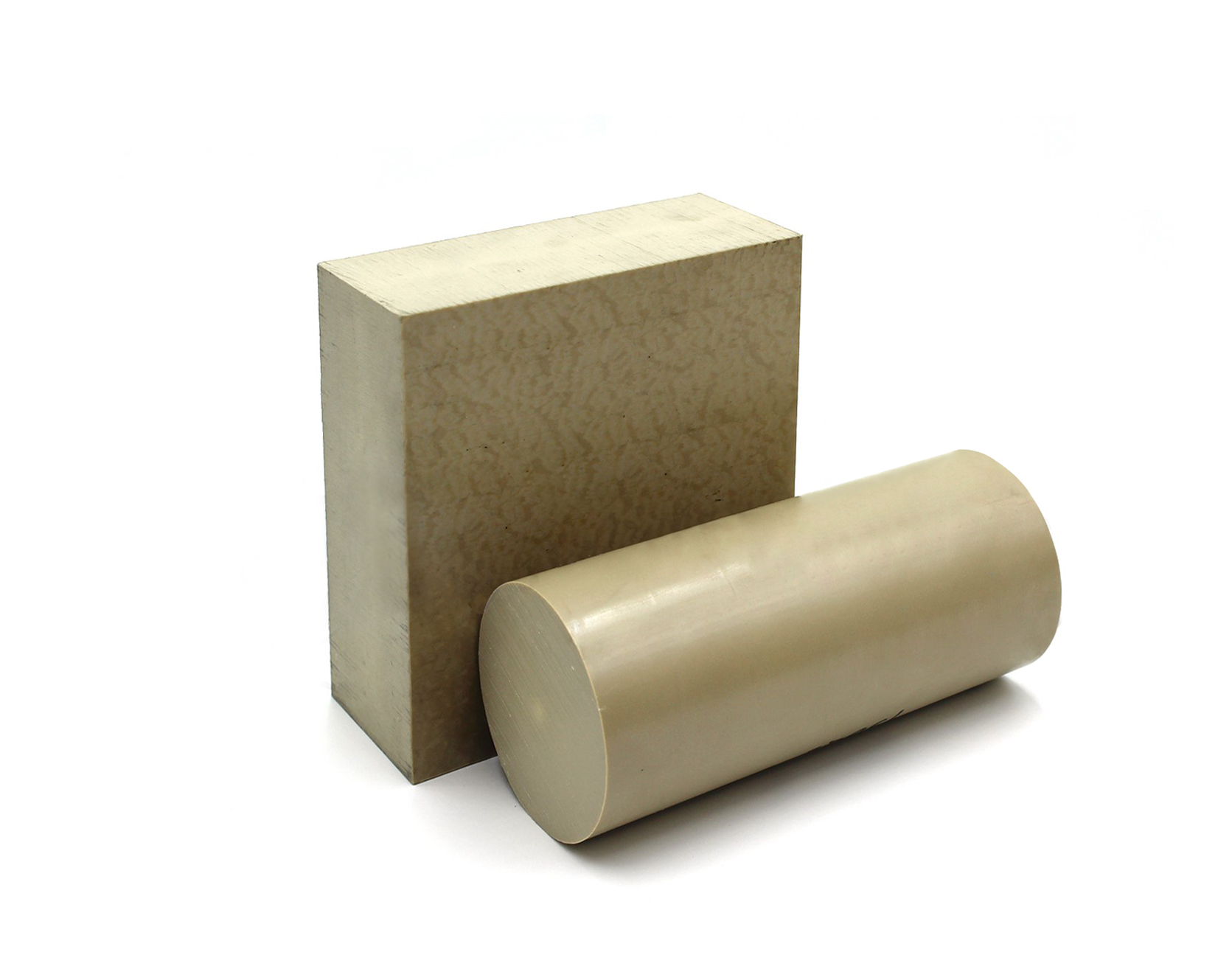
Extruded PEEK rod, by contrast, carries a pronounced flow-axis orientation: CLTE and conductivity are reported as along-flow vs transverse, e.g. Victrex 450G rod/flow data gives along-flow CLTE 45 ppm/K below Tg and average 55 ppm/K, along-flow conductivity 0.32 vs average 0.29 W/m·K.
Termally this means rod stock develops radial gradient stress under heat cycle, plate stock develops planar differential expansion — so annealing goals differ (rod straightness vs plate flatness) even though the polymer Tm/Tg are identical . For plate buyers, specify average-plane conductivity; for turned rod parts specify along-flow conductivity.
PEEK sheet stands as the baseline material for semiconductor carriers, medical sterilization trays, and aerospace thermal-structure components, primarily due to its tiered high-temperature profile of heat deflection and long-term service capability.
In the unfilled grade, the plate exhibits a heat deflection temperature (HDT) of 152°C per ISO 75(1.8 MPa) and a glass transition at 143°C per ISO 11357, meaning the material will not collapse under planar thermal load in the 100–120°C zone as common engineering thermoplastics do. Glass-fiber 30% (GF30) and carbon-fiber 30% (CF30) grades push HDT to the 315–336°C range, allowing thick plates to retain rigid contour under high internal pressure or clamped thermal conditions.
More critically, its long-term thermal aging resistance—per UL 746B Relative Thermal Index (RTI)—shows unfilled plate achieving RTI Elec 260°C, RTI Mech w/o imp 240°C, and RTI Mech w/imp 180°C; GF30/CF30 plates hold mechanical retention near 240°C, with 50% property retention guaranteed after 60,000–100,000 hours (≈6.8–11.4 years) of heat aging. This dual thermal barrier of "short-term HDT resistance + long-term RTI endurance" delivers three irreplaceable functions:
Dimensional stability as a carrier substrate during 134°C steam sterilization or 200°C dry-heat cycles;
Maintained electrical insulation and low outgassing in 260°C continuous process zones (e.g., wafer thermal trays);
Metal replacement in automotive and energy hot sections for weight reduction without sacrificing thermal demarcation.
The advantages consolidate into a naturally high thermal threshold from the semi-crystalline matrix, customizable HDT elevation via fillers, and UL Yellow Card–backed RTI credibility for full-lifecycle heat reliability, enabling buyers and machinists to specify grade by documented temperature class rather than empirical risk.
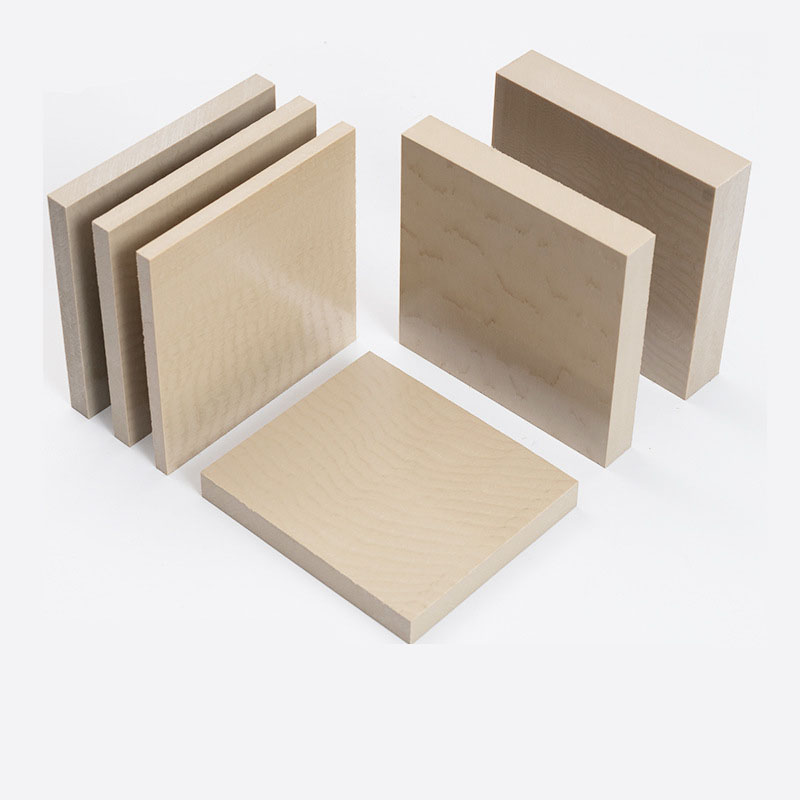
| Grade (plate) | HDT 1.8MPa (ISO 75) | Continuous / RTI Elec | RTI Mech w/o imp (UL 746B) | Melt point(ISO 11357) |
|---|---|---|---|---|
| Unfilled PEEK | 152°C | 260°C | 240°C | 343°C |
| PEEK GF30 | 315°C | 260°C | 240°C | 343°C |
| PEEK CF30 | 336°C | 260°C | 240°C | 343°C |
| PEEK ESD (anti-static modified) | 315°C | 260°C | 240°C | 343°C |
Per ISO 11359-2, plate CLTE splits at Tg 143°C [20,5](@ref):
Unfilled plate – below Tg average 55 / along-flow 45 ppm/K; above Tg average 140 / along-flow 120 ppm/K .
GF30 plate – below Tg average ~18–22 / along-flow 18–22; above Tg average ~18–22 .
CF30 plate – below Tg average 15 / along-flow 5–15; above Tg average 20 / along-flow 6 .
ESD plate – modified PEEK base, 37–42 ppm/K over 23–100°C depending on filler.
For 770×1240mm plate, unrestricted expansion at 100°C swing: unfilled ~55 ppm/K × 1240mm × 77K ≈ 5.2mm total plane growth if unclamped; fixtures must absorb this. Anneal only reduces residual stress, not the coefficient itself.
PEEK sheet thermal conductivity ascends in a graded staircase across filler grades, forming a complete spectrum from insulation to uniform heat spreading.
Per ISO 22007-4, unfilled virgin plate exhibits quasi-isotropic in-plane conduction with an average of ~0.29 W/m·K and along-flow value of 0.32 W/m·K, making it suitable as a low-dissipation electrically insulating carrier substrate.
GF30 glass-filled plate marginally lifts in-plane conductivity to 0.30–0.35 W/m·K, enhancing rigidity while maintaining thermal balance.
CF30 carbon-fiber plate delivers a qualitative leap: in-plane isotropy reaches 0.95 W/m·K (along-flow near 0.95–1.0), roughly 3× unfilled, enabling uniform transient heat diffusion and hot-spot suppression in wafer thermal trays.
ESD anti-static modified plate, via carbon-based addition, also shows enhanced conductivity (typically 0.45–0.57 W/m·K), with exact values governed by additive type and loading, balancing electrostatic dissipation with moderate heat transfer.
This grade-tunable conductivity spectrum allows designers to match grade to defined heat-flux density, preventing over-engineering or thermal runaway.
| Grade | Average Plane (W/m·K) | Along-Flow (W/m·K) |
|---|---|---|
| Unfilled PEEK | 0.29 | 0.32 |
| PEEK GF30 | 0.30 | 0.35 |
| PEEK CF30 | 0.95 | 0.95–1.0 |
| PEEK ESD | depends on filler | |
Q1: Which PEEK sheet grade delivers the highest heat deflection temperature (HDT)?
A: GF30 and CF30 reinforced plates both reach the top tier—HDT 315–336°C per ISO 75-f (1.8 MPa), above unfilled 152°C. Between them, CF30 adds isotropic 0.95 W/m·K conduction, GF30 holds 0.30–0.35 W/m·K.
Q2: Which PEEK sheet grade shows best creep resistance at elevated temperature?
A: CF30 and GF30 plates, with HDT ~315–336°C and fiber-restrained matrix, outperform unfilled in long-term load at 200–260°C. CF30 especially resists creep via uniform 0.95 W/m·K plane cooling reducing gradient stress.
Q3: Which PEEK sheet grade retains the best toughness / impact behavior?
A: Unfilled virgin PEEK sheet leads—UL 746B RTI Mech w/imp 180°C with high elongation. Specify Unfilled PEEK Sheet Specs for high-toughness blanks before fillers.
Q4: How does in-plane thermal conductivity differ between unfilled and CF30 plate?
A: Per ISO 22007-4, unfilled ~0.29 W/m·K average plane; CF30 lifts to ~0.95 W/m·K isotropic in face—≈3× higher—enabling transient heat spread for semiconductor trays while unfilled serves insulation.
Q5: Can PEEK sheet sustain 260°C continuous service without collapse?
A: Yes. All grades hold continuous 260°C per UL 746B; melt at 343°C gives margin. Unfilled RTI Elec 260°C; filled Mech w/o imp ~240°C. Anneal only locks dimensional repeatability, not thermal ceiling.


