Views: 0 Author: Rio Liang Publish Time: 2026-09-27 Origin: Site


Content Menu
● Quick answer: Why use a 30% content of glass fiber to reinforce PEEK material?
● How does the content of glass fibers affect the tensile and flexural strength of PEEK materials?
● How does the content of glass fibers affect the tensile and flexural moduli of PEEK materials?
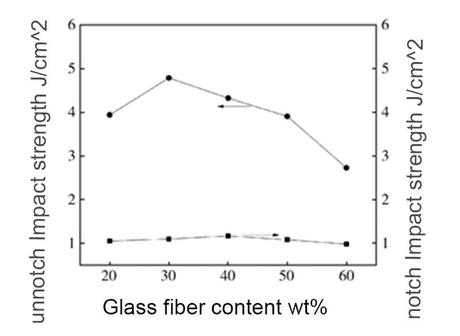
● How does the content of glass fibers affect the impact strength of PEEK materials?
● How to choose different grade glass fiber filled PEEK?
30 wt% glass fiber is a commonly used reinforcement level for PEEK because it provides a practical balance between stiffness, strength, impact performance and processability.
However, the optimum glass-fiber content depends on application requirements,need more stiffness & strength can choose higher glass content,but higher content will resulting in
lower toughness.
In the referenced study, the unnotched impact strength reached its maximum at approximately 30 wt% glass fiber under the reported test conditions.
The above conclusion is based on the paper: DING Haoliang, TANG Wei, WEI Sai, LI Fan, ZHAO Yunfeng. Development of Bearing Bracket Made From Polyether Ketone by Shot Glass Fiber Reinforced. Aerospace Materials & Technology, 2018, 48(5): 73-77.
The tensile properties were tested in accordance with GB/T1040.2—2006, with a tensile rate of 5 mm/min
The flexural properties were tested in accordance with GB/T9341—2008, with a flexural rate of 2 mm/min;
The impact properties were tested in accordance with GB/T1043.1—2008;
The glass fiber content was tested in accordance with GB/T2577—2005.
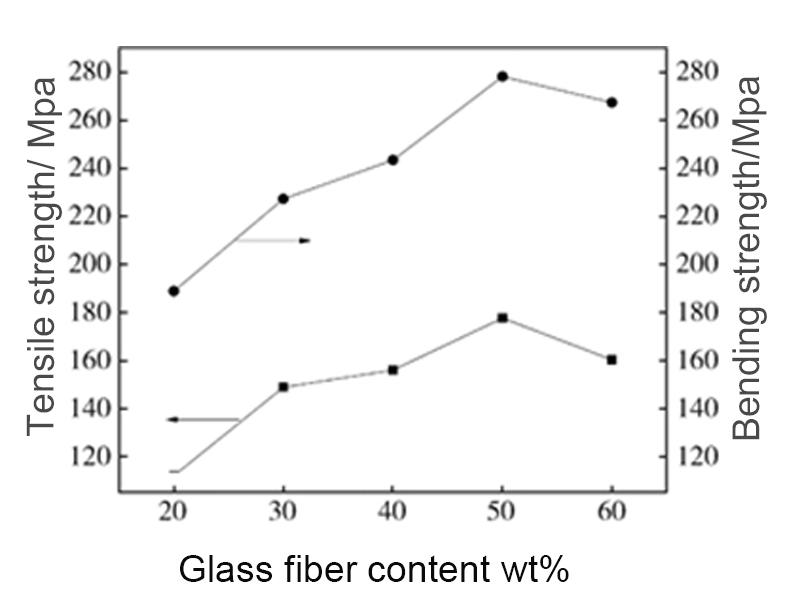
By check on the picture above,we can see PEEK material at low glass fiber content, the tensile and flexural strengths increase with the increase of glass fiber content. When the glass fiber content reaches 50wt%, the strength of the material reaches its maximum value, and then decreases as the glass fiber content increases.
The reason for this change is the combined effect of glass fiber content and fiber retention length. When the glass fiber content is low, the glass fibers break less, and the glass fiber content plays a major role in the material strength; when the glass fiber content is high, the glass fibers break more severely, and the retention length of the glass fibers plays a decisive role, and the strength decreases as the retention length of the glass fibers decreases. When the glass fiber content reaches 50wt%, the material has a good retention length of glass fibers and an appropriate glass fiber content, so the tensile and flexural strengths reach their maximum.
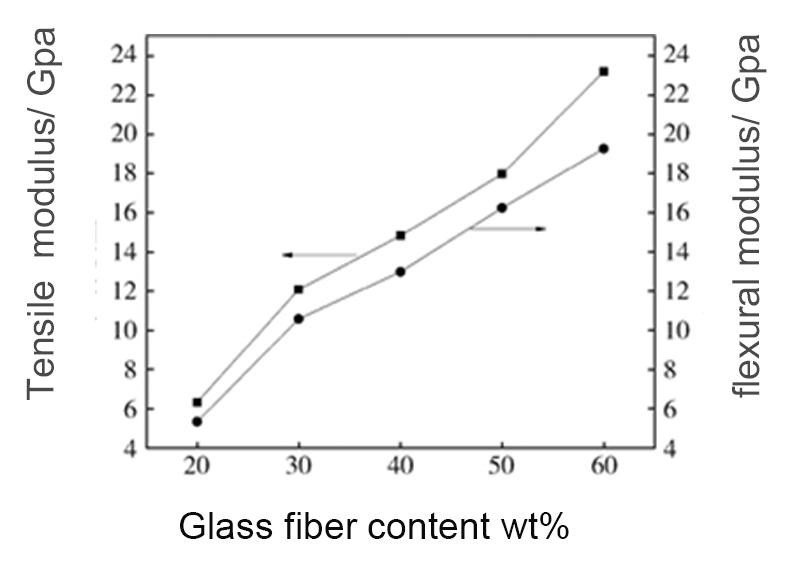
as we can see,The tensile modulus and flexural modulus of PEEK material will increase as the content of glass fibers increases. Even when the content exceeds 50%, the enhancement effect on the PEEK modulus remains very significant.This indicates that the modulus is mainly related to the content of glass fibers.
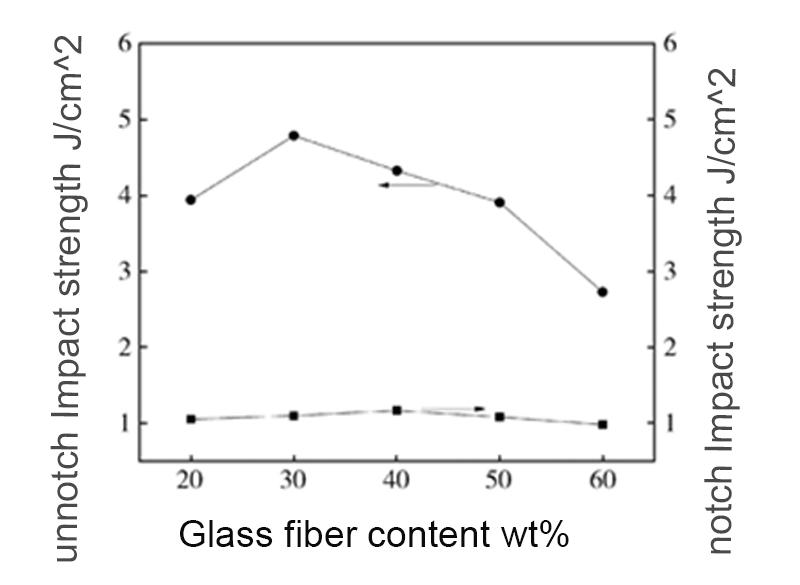
The unotchimpact strength increases initially and then decreases with the increase of glass fiber content. When the glass fiber content reaches 30wt%, it reaches the maximum value. However, the impact strength with notch shows no significant change with the increase of glass fiber content, remaining at around 1.0 J/cm2. This indicates that the material is sensitive to the notch but not sensitive to the glass fiber content.
| Glass Fiber Content | General Effect |
|---|---|
| Low | Limited reinforcement |
| 20 wt% | Increased stiffness and strength |
| 30 wt% | Balance of properties; widely used grade |
| 40 wt% | Higher stiffness, potentially lower toughness |
| 50 wt%+ | Strong reinforcement but greater processing/fiber-retention considerations |
From the above analysis, it can be concluded that when the content of glass fibers is below 50wt%, as the content of glass fibers increases, the strength and modulus of the material gradually increase, but the impact toughness and elongation at break gradually decrease. Considering the material properties comprehensively, 30wt% Glass fiberPEEK is selected as the material for the load-bearing support.