|


| Material: | |
|---|---|
| Electrostatic protection value: | |
| MOQ: | |
| Packing: | |
| Quantity: | |
PEEK-880ESD
PRES
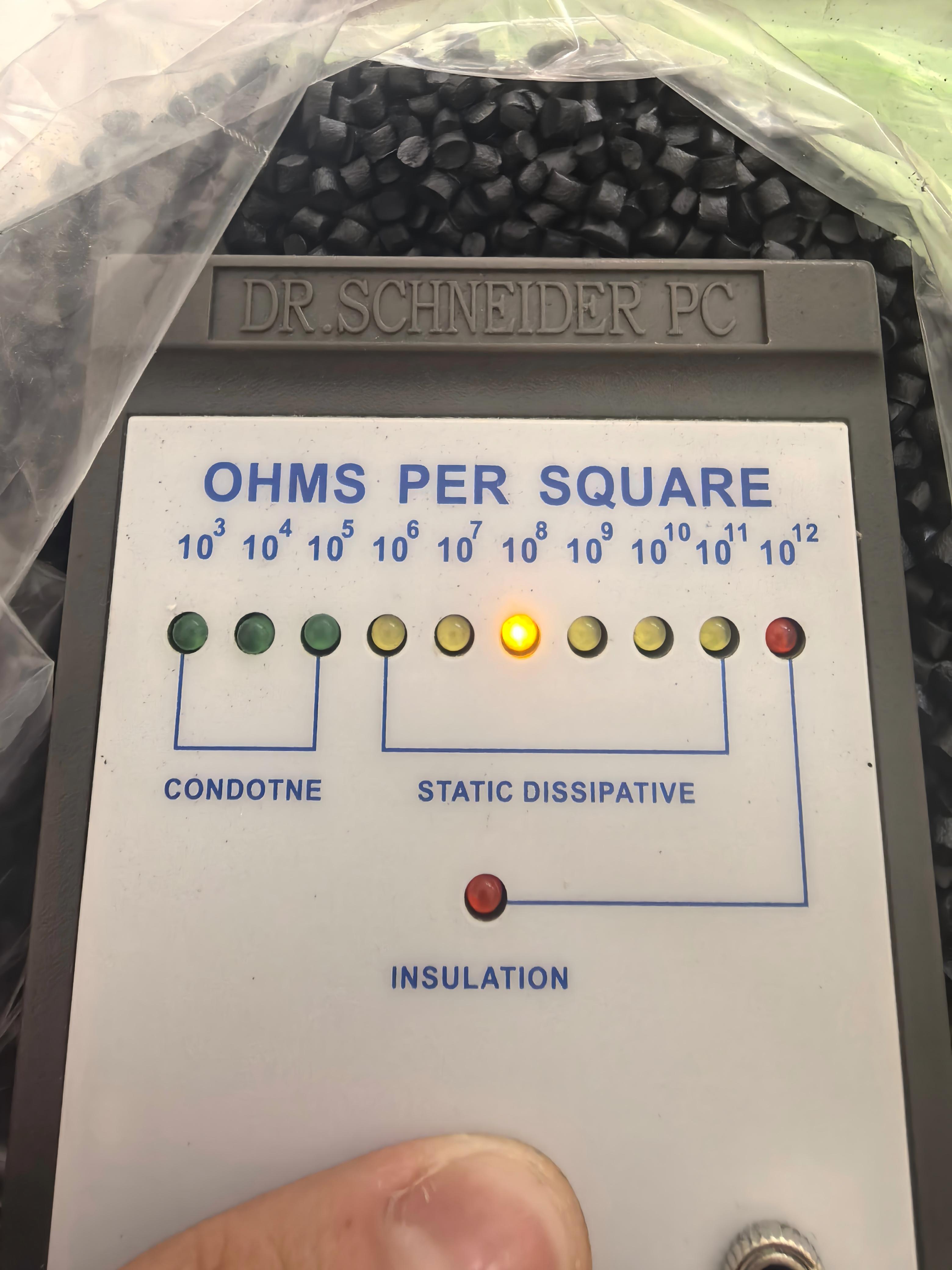
PRES ESD PEEK pellets achieve electrostatic dissipative properties through a conductive network formed by interconnected conductive fillers within the PEEK matrix. Carbon fiber is used as the conductive filler in the PRES ESD PEEK grade.
This carbon-fiber reinforcement provides a combination of controlled electrical resistance and high mechanical performance. For the specified PRES grade, representative properties include a surface resistivity of 106–109 Ω/sq, tensile strength of approximately 210 MPa, flexural modulus of approximately 16 GPa, and HDT up to 325°C (617°F). The material also exhibits a low coefficient of linear thermal expansion, approximately 8 ppm/K above Tg under the specified test conditions.
Low shrinkage(0.2% along flow,0.7% across flow test unber ISO 294-4) and high flow enable tight-tolerance ESD-safe components without post-molding coatings.
✔️ ESD-Safe by Nature: No carbon sloughing or coating degradation.
✔️ Metal-Replacement Capable: Lightweight alternative to aluminum in static-sensitive assemblies.
✔️ Cleanroom Compatible: Low outgassing, chemically inert, and dimensionally stable.
Injection grade antistatic PEEK is widely used for precision-molded components that must safely dissipate static while enduring high heat and aggressive chemicals.
| Property | Units | Test Method | Typical Value |
|---|---|---|---|
| Electrical | |||
| Surface Resistivity | Ω/sq | ASTM D257 | 106 – 109 |
| Volume Resistivity | Ω·cm | ASTM D257 | 106 – 109 |
| Thermal | |||
| Glass Transition Temp (Tg) | °C | D3418 | 143 |
| Melting Temp (Tm) | °C | D3418 | 343 |
| Continuous Use Temp | °C | – | 260 |
| Thermal Expansion Coefficient(below Tg) | ppm/K | ISO 11359 | 8 |
| Thermal Expansion Coefficient(over Tg) | ppm/K | ISO 11359 | 8 |
| Mechanical | |||
| Tensile Strength | MPa | ISO 527 | 210 |
| Flexural Modulus | GPa | ISO 178 | 16 |
| Processing | |||
| Melt Temperature | °C | – | 370 – 390 |
| Mold Temperature | °C | – | 160 – 190 |
| Note: The mechanical properties shown are representative values measured under specified standard test conditions. Actual molded-part performance depends on part geometry and processing conditions, including gate design, screw speed, and injection parameters. Excessive carbon-fiber breakage can reduce the effective reinforcement and result in lower mechanical strength. | |||
Tested by PRES Material Lab (ISO 17025 accredited) in Feb 202
6Supplied to 3 leading Asian OSATs for IC test sockets since 2024
106–109Ω/sq resistivity retained after 50 autoclave cycles (PRES internal test)