Views: 236 Author: Dongguan PRES Publish Time: 2026-09-22 Origin: Site


Content Menu
● What Are Impact Resistant Plastics?
● Why Choose PRES for Impact Resistant Plastics?
>> Our High-Performance Plastic Product Forms
>> OEM Support for International Buyers
● Common Types of Impact Resistant Plastics
>> Polycarbonate: High Impact Performance With Transparency
>> ABS: Practical Toughness for Housings and Consumer Products
>> Nylon: Tough Engineering Plastic for Mechanical Parts
>> HDPE and UHMW-PE: Toughness, Chemical Resistance, and Low Friction
>> TPU: Flexible Impact Protection and Abrasion Resistance
● How We Select the Right Impact Resistant Plastic
>> Step 1: Define the Real Impact Event
>> Step 2: Compare More Than Impact Strength
>> Step 3: Design the Part to Protect the Material
● Impact Testing and Quality Control
>> What Buyers Should Request From a Supplier
>> Expert Insight: Validate the Finished Component
● Industry Applications for Impact Resistant Plastics
>> Electronics and Electrical Enclosures
>> Automotive and Transportation Components
>> Industrial Machinery and Material Handling
>> Safety, Protection, and Transparent Guards
>> 3D Printing and Rapid Manufacturing
● Partner With PRES for Reliable Impact Resistant Plastic Solutions
● FAQs
>> 1. What is the best impact resistant plastic?
>> 2. Is polycarbonate stronger than ABS for impact resistance?
>> 3. How is plastic impact resistance measured?
>> 4. Does cold temperature affect impact resistant plastics?
>> 5. Can impact resistant plastics be CNC machined?
>> 6. Can PRES provide OEM packaging for overseas customers?
>> 7. Are 3D-printed impact resistant parts suitable for production?
Impact resistant plastics are essential when a component must survive drops, vibration, repeated handling, sudden loads, and harsh service conditions without cracking or catastrophic failure. At Dongguan PRES Group Co., Ltd., we supply high-performance plastic materials in pellets, sheets, rods, tubes, powders, and high-performance 3D-printing filaments—while supporting overseas brands, wholesalers, and manufacturers with flexible OEM solutions.
For buyers, choosing an impact resistant plastic is not simply about finding the "strongest" polymer. The right decision requires balancing impact strength, temperature performance, stiffness, chemical resistance, surface requirements, processing method, regulatory needs, and total lifecycle cost. Our role at PRES is to help turn those requirements into a material solution that is practical to manufacture and dependable in the field.

Impact resistant plastics are polymer materials designed to absorb sudden mechanical energy and resist cracking, splitting, or breaking when struck, dropped, or stressed. In practical terms, they help components remain functional when real-world use is less controlled than laboratory conditions.
At PRES, we view impact resistance as a system property—not a single number on a data sheet. A plastic may show good impact strength at room temperature but become brittle in cold conditions. Another material may survive a single drop but fail after repeated vibration, chemical exposure, UV aging, or stress concentration around a sharp corner.
That is why material selection must consider the actual application environment.
Common examples of components that benefit from impact resistant plastics include:
- Electronic housings and device enclosures
- Automotive interior and exterior components
- Machine guards and protective covers
- Industrial fixtures, jigs, and wear parts
- Safety equipment and protective shields
- Medical-device housings
- Outdoor equipment and transport cases
- Consumer-product casings
- 3D-printed prototypes and functional production parts
- Chemical-handling and fluid-system components
Impact resistance is closely linked to toughness. A tough plastic can absorb energy and deform before fracture, while a brittle material may crack suddenly under a lower-impact event. Standardized tests such as ASTM D256 notched Izod impact testing help compare a material's resistance to a controlled impact event and evaluate notch sensitivity.
PRES is a China-based high-performance plastics manufacturer and OEM partner focused on helping international customers source materials that perform consistently from development through production.
We understand that global buyers need more than a catalog item. They need a supplier that can support material form, machining or molding requirements, batch consistency, communication, packaging, and commercial flexibility.
PRES supplies impact resistant plastic materials in multiple forms to fit different production processes:
| Product form | Typical customer use | Key buyer advantage |
|---|---|---|
| Plastic pellets | Injection molding, extrusion, compounding | Efficient for volume manufacturing |
| Plastic sheets | CNC machining, thermoforming, fabrication | Suitable for prototypes and finished panels |
| Plastic rods | Machined bushings, gears, fixtures, insulators | Reduces waste for turned components |
| Plastic tubes | Fluid handling, protective sleeves, industrial parts | Supports lightweight, corrosion-resistant designs |
| Plastic powders | Rotational molding, coating, sintering, specialty processing | Enables process-specific material use |
| 3D-printing filaments | Functional prototypes, fixtures, low-volume production | Faster material validation and iteration |
For overseas brands, wholesalers, and manufacturers, PRES provides OEM-oriented support designed around your commercial and technical requirements.
Our OEM approach can include:
- Custom material selection based on use conditions
- Customized dimensions for sheets, rods, tubes, and profiles
- Color matching and appearance requirements
- Private-label packaging and brand presentation
- Application-focused product recommendations
- Support for samples and material validation
- Supply planning for repeat orders and wholesale programs
- Communication tailored to export customers
A reliable material partner should help prevent expensive errors before production begins. We encourage customers to share the actual operating conditions: impact type, part geometry, temperature range, exposure to chemicals, expected service life, compliance needs, and preferred processing method.
There is no universal "best impact resistant plastic." The right grade depends on the part's mechanical, environmental, visual, and manufacturing requirements.
Polycarbonate (PC) is widely selected for applications requiring high impact resistance, dimensional stability, and optical clarity. It is commonly considered for transparent guards, safety shields, equipment windows, protective covers, lighting components, and electronics housings.
Key considerations include:
- Excellent toughness for many impact-sensitive uses
- Transparent grades are available
- Good dimensional stability
- Can require attention to chemical compatibility and stress cracking
- Processing conditions strongly affect final part quality
Polycarbonate is often a strong starting point when a customer needs both visibility and impact protection. However, design engineers should confirm exposure to cleaning agents, oils, fuels, or other chemicals before finalizing the material.
ABS, or acrylonitrile butadiene styrene, offers a useful balance of impact performance, rigidity, processability, and cost. It is widely used in electronic housings, appliance components, automotive trim, consumer goods, and functional prototypes.
ABS is often valued because it is:
- Easy to mold and machine
- Suitable for many painted or textured surfaces
- Available in many colors
- Practical for high-volume housing applications
- Compatible with common prototyping workflows
For products that face occasional drops or daily handling rather than extreme impact exposure, ABS can be an efficient and economical choice.
Nylon, including PA6 and PA66 families, is frequently used where impact resistance must be combined with wear resistance, strength, and fatigue performance. It is common in gears, bushings, rollers, brackets, industrial components, and automotive parts.
Its advantages often include:
- Good toughness and mechanical strength
- Strong wear resistance for moving parts
- Useful fatigue performance
- Lower weight than many metal alternatives
- Potential for reinforcement or modification
However, nylon can absorb moisture, which may affect dimensions and mechanical behavior. We advise customers to evaluate moisture exposure, tolerances, and conditioning requirements early in the design process.
HDPE and UHMW-PE are important choices where impact resistance, chemical resistance, low moisture absorption, and low friction matter. Applications may include liners, chutes, tanks, wear strips, transport components, cutting boards, and material-handling systems.
UHMW-PE is especially useful for abrasive or sliding contact environments because of its excellent wear behavior and low coefficient of friction. It can be a practical solution for industrial handling equipment where impact occurs alongside repeated abrasion.
TPU, or thermoplastic polyurethane, is ideal when the part must flex repeatedly while resisting impact and abrasion. It is used in protective cases, flexible guards, wheels, seals, cable protection, sporting goods, and certain 3D-printed functional parts.
TPU offers:
- High elasticity
- Excellent abrasion resistance
- Good tear resistance
- Strong vibration damping potential
- Flexible performance across many use cases
For a part that needs to bend, cushion, or recover after impact, TPU may outperform a rigid engineering plastic.
As material specialists, we recommend starting with the failure risk—not with a polymer name. A part that is dropped from a workstation faces a different impact condition than a conveyor guide exposed to repetitive loading, a transparent machine guard, or an automotive bracket operating in hot and cold climates.
Ask the following questions:
1. What strikes the part? Consider weight, shape, speed, and contact area.
2. How often will impact occur? A one-time impact and repeated impact create different risks.
3. At what temperature will the part operate? Cold environments can reduce toughness in some plastics.
4. Where is the part most likely to crack? Corners, holes, notches, threads, and thin walls are common failure points.
5. Will the part contact chemicals, UV light, moisture, or cleaning agents? Environmental exposure can change long-term performance.
6. How will the part be manufactured? Injection molding, CNC machining, extrusion, thermoforming, and 3D printing affect suitable material choices.
This process avoids a common purchasing mistake: selecting a material based only on a generic impact rating while overlooking geometry and real service conditions.
A notched Izod value is useful, but it should not be the only decision factor. Notched Izod testing measures the energy required to break a notched specimen under a pendulum impact, making it particularly valuable for understanding notch sensitivity and comparing materials under controlled conditions.
When comparing impact resistant plastics, evaluate:
- Notched Izod or Charpy impact strength
- Tensile strength
- Flexural modulus or stiffness
- Heat-deflection temperature
- Continuous-use temperature
- Chemical resistance
- UV and weathering resistance
- Moisture absorption
- Flammability requirements
- Electrical properties
- Surface finish and color stability
- Machinability, moldability, and printability
- Cost and supply continuity
Even the best impact resistant plastic can fail if a part is poorly designed. Material selection and part design should work together.
For stronger, more reliable plastic parts:
- Use generous radii instead of sharp internal corners
- Avoid abrupt changes in wall thickness
- Reinforce high-load zones with ribs where appropriate
- Keep holes and cutouts away from highly stressed edges
- Consider impact direction and support points
- Use appropriate assembly clearances to reduce residual stress
- Validate the finished part, not only the raw material
This is particularly important for CNC-machined sheets and rods, injection-molded components, and 3D-printed parts, where orientation, residual stress, and processing conditions can influence impact behavior.
For international procurement, consistent quality matters as much as a material's headline properties. A material grade must perform reliably across batches, production runs, and shipped components.
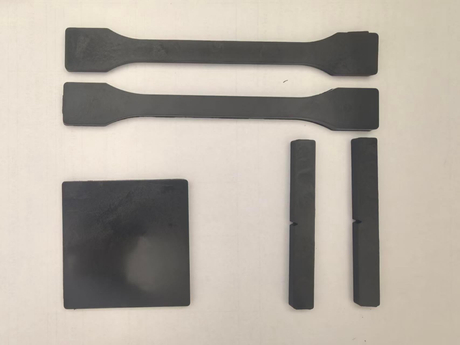
ASTM D256 is a widely used test method for determining Izod pendulum impact resistance of plastics. The test uses a pendulum to strike a standardized specimen, allowing manufacturers and buyers to compare performance and assess notch sensitivity.
Before approving an impact resistant plastic for production, request and review:
- Technical data sheet
- Material grade identification
- Test method and test conditions
- Impact-test data, including units and specimen condition
- Color and appearance requirements
- Dimensions and tolerances
- Batch traceability where required
- Sample parts or trial material
- Packaging requirements
- Compliance documentation when applicable
A critical detail is test condition. Results can vary with specimen thickness, notch type, temperature, moisture condition, processing history, and test standard. Therefore, two impact values should not be compared blindly unless the test conditions are aligned.
A material test bar is useful, but your final part has weld lines, corners, screw bosses, ribs, holes, varying thicknesses, and production variables. These features can create stress concentrations that do not exist in a standardized specimen.
For high-risk applications, PRES recommends a practical validation route:
1. Select two or three candidate materials.
2. Produce samples using the intended manufacturing method.
3. Condition samples at realistic temperature and humidity levels.
4. Conduct controlled drop, strike, vibration, or fatigue testing.
5. Inspect for cracks, whitening, deformation, loosening, and dimensional change.
6. Review results before moving to volume production.
This approach helps buyers reduce field failures, rework costs, warranty risk, and production interruptions.
Electronic housings need to manage accidental drops, repeated handling, fastening stress, heat, and cosmetic expectations. ABS, PC, PC/ABS blends, and flame-retardant engineering plastics are often considered depending on the application.
Key selection priorities may include:
- Drop resistance
- Surface appearance
- Flame-retardancy needs
- Dimensional stability
- Snap-fit durability
- Electrical insulation performance
Vehicle components may encounter vibration, temperature cycling, impact, UV exposure, and chemical contact. Impact resistant plastics are commonly used in interior trim, protective covers, brackets, housings, and lightweight structural or semi-structural components.
The right grade must be selected for the specific location. Interior applications may prioritize surface quality and impact resistance, while under-hood applications often require higher thermal and chemical resistance.
Industrial equipment frequently needs plastics that can absorb impact while resisting abrasion, chemicals, and continuous use. UHMW-PE, HDPE, nylon, acetal, and reinforced engineering plastics may be evaluated for wear strips, guides, rollers, guards, fabricated tanks, and machine components.
For safety guards, face shields, protective windows, and transparent covers, polycarbonate is often evaluated because it can combine impact resistance with clarity. The final choice should consider thickness, mounting method, cleaning chemistry, scratch resistance, and relevant safety requirements.
High-performance 3D printing enables fast functional prototypes, fixtures, low-volume replacement parts, and design validation. Impact resistant 3D-printing filaments can help engineers test real-world fit, assembly behavior, and drop resistance before investing in production tooling.
For best results, evaluate:
- Print orientation
- Layer adhesion
- Infill design
- Nozzle temperature
- Drying conditions
- Wall thickness
- Post-processing requirements
The same polymer family can perform differently depending on whether it is supplied as pellets, sheet, rod, tube, powder, or filament.
For example:
- Pellets are suitable for customers with injection molding or extrusion capability.
- Sheets and rods support rapid CNC machining for prototypes, jigs, fixtures, and low-volume industrial components.
- Tubes can simplify fluid, insulation, or protective-sleeve applications.
- Powders may support specialized coating, sintering, or molding routes.
- 3D-printing filaments accelerate prototype testing and small-batch production.
At PRES, we help buyers choose a material format that fits both their technical requirement and production economics. A material that is technically excellent but inefficient to process may increase the total cost of the finished part.
Choosing impact resistant plastics should be a disciplined engineering and sourcing decision. The goal is not merely to obtain a high impact-test value; it is to build a component that remains safe, functional, manufacturable, and commercially viable throughout its intended service life.
Dongguan PRES Group Co., Ltd. supports international brands, wholesalers, and manufacturers with high-performance plastic pellets, sheets, rods, tubes, powders, and 3D-printing filaments. Whether you need a durable electronic enclosure material, a machinable industrial sheet, a wear-resistant rod, a flexible protective filament, or an OEM-ready supply program, PRES can help you move from material selection to production confidence.
Contact PRES today to discuss your application, request material recommendations, obtain samples, or develop a customized OEM solution for impact resistant plastics.
There is no single best option for every application. Polycarbonate is often selected for high-impact transparent applications, ABS for practical housings, nylon for tough mechanical parts, UHMW-PE for wear and impact environments, and TPU for flexible protective components. The best choice depends on temperature, chemicals, geometry, manufacturing method, and required service life.
Polycarbonate generally provides higher impact resistance than standard ABS, especially in applications requiring toughness and transparency. However, ABS may be more economical and easier to process for many housings and consumer-product applications. Final selection should include testing under actual use conditions.
Plastic impact resistance is often measured with Izod or Charpy pendulum impact tests. ASTM D256 is a common standard for measuring Izod impact resistance in plastics. The result represents the energy absorbed by a specimen during fracture under specified test conditions.
Yes. Many plastics become less tough at low temperatures, and some can transition toward brittle behavior. If a product will be used outdoors, in refrigerated spaces, or in cold transportation conditions, testing at the expected operating temperature is important.
Yes. Many impact resistant plastic sheets, rods, and tubes can be CNC machined into custom parts. Material selection should consider machinability, dimensional tolerance, heat generation during machining, moisture absorption, and final-service requirements.
Yes. PRES supports OEM cooperation for international brands, wholesalers, and manufacturers. Depending on the project, this can include customized product forms, dimensions, colors, packaging, labeling, and supply arrangements.
They can be suitable for prototypes, fixtures, low-volume parts, and selected end-use applications. However, 3D-printed parts may behave differently from injection-molded parts because layer adhesion, print orientation, infill, and processing conditions influence mechanical performance. Functional testing is recommended before final approval.
1. Intertek. "Izod Impact (Notched) ASTM D256, ISO 180." Explains notched Izod impact testing, its use in evaluating plastic toughness and notch sensitivity, and the typical test approach. [Intertek – Izod Impact Testing] [intertek]
2. ZwickRoell. "ASTM D256: Notched Izod Impact Strength of Plastics." Discusses ASTM D256 applications in material development, production quality control, incoming inspection, and evaluation of environmental effects on impact performance. [ZwickRoell – ASTM D256] [zwickroell]
3. SpecialChem. "Impact-Resistant Plastics: Properties, Types, Applications." Provides industry context on the relationship between toughness, flexibility, temperature stability, durability, chemical resistance, and impact performance. [SpecialChem – Impact Resistance Guide] [specialchem]
4. SpecialChem. "Toughness of Plastic Materials: Notched Izod Impact Test." Covers the role of impact testing, relevant Izod and Charpy standards, and the relationship between absorbed energy and material toughness. [SpecialChem – Toughness Guide] [specialchem]
5. ASTM International via iTeh Standards. "ASTM D256-23e1: Standard Test Methods for Determining the Izod Pendulum Impact Resistance of Plastics." Summarizes the purpose of the ASTM D256 standard and its role in material comparison and quality control. [iTeh – ASTM D256-23e1] [standards.iteh]
6. Protolabs. "Common Impact-Resistant Plastics." Notes the importance of application temperature, tensile strength, UV resistance, and producing sample parts before committing to a material. [Protolabs – Common Impact-Resistant Plastics] [protolabs]
Hot Tags: China, Global, OEM, private label, manufacturers, factory, suppliers, manufacturing company