Views: 225 Author: Dongguan PRES Publish Time: 2026-10-19 Origin: Site


Content Menu
● Polyetherimide Polymer in Oil & Gas: Where PEI Fits
● Understanding PEI Heat Resistance Without Overstating Its Limits
● PEI Resistance to Downhole Sour Gas: What Buyers Must Verify
>> Evaluate the Entire Fluid Mixture
>> Consider H₂S Partial Pressure
● High-Pressure PEI Components: Why Geometry Matters
>> Separate Pressure From Mechanical Stress
>> Review Interfaces and Manufacturing Effects
● Rapid Gas Decompression: A Separate Qualification Question
● A Practical PEI Qualification Workflow for OEM Buyers
>> Step 1: Define the Component's Function
>> Step 2: Freeze the Material and Manufacturing Route
>> Step 3: Establish Baseline Measurements
>> Step 4: Perform Representative Exposure Testing
>> Step 5: Reassess the Finished Component
● PEI vs. PEEK for Sour-Gas Applications
● Choosing PEI Product Forms for OEM Development
● An Illustrative Downhole Sensor Selection Scenario
● Start Your PEI OEM Review With PRES
>> 1. Is polyetherimide automatically suitable for sour-gas service?
>> 2. Can PEI withstand high pressure?
>> 3. Does a 217°C glass transition temperature mean continuous operation at 217°C?
>> 4. Does ISO 23936-1 testing cover rapid gas decompression?
>> 5. Can PEI replace PEEK in downhole equipment?
>> 6. Are 3D printed PEI parts ready for pressure service?
>> 7. What should buyers request from a PEI OEM supplier?
Dongguan PRES Group Co., Ltd. supplies high-performance plastic products and OEM services for international brands, wholesalers, and manufacturers. Our portfolio includes pellets, sheets, rods, tubes, powders, and high-performance 3D printing filaments. For buyers researching "Polyetherimide Polymer in Oil & Gas: Resistance to Downhole Sour Gas and High Pressure," the essential question is straightforward: can a particular PEI grade maintain its required properties throughout the intended service life?
Polyetherimide offers an attractive combination of heat resistance, stiffness, dimensional stability, and electrical insulation. However, these benefits do not automatically establish suitability for hydrogen sulfide exposure or pressure-containing components.
Our position is simple: qualification must come before performance claims. This guide explains how to evaluate PEI for oilfield applications and prepare a more useful OEM sourcing specification.
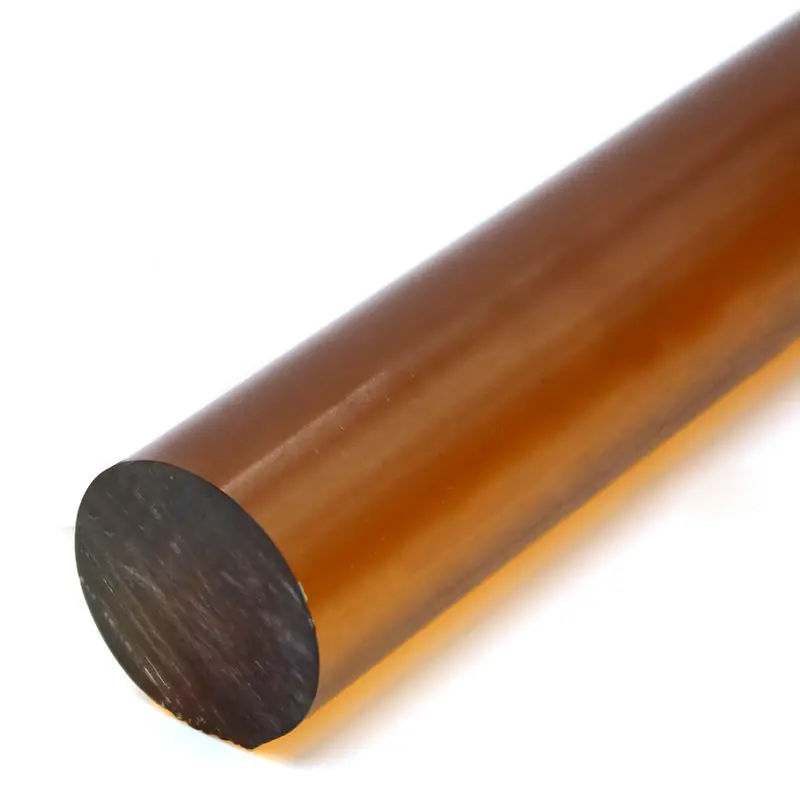
PEI is an amorphous engineering thermoplastic. Unlike semicrystalline polymers, it does not contain a crystalline phase. Its thermal and mechanical performance makes it worth evaluating for components requiring precise dimensions and electrical isolation.
Potential applications include:
- Electrical insulators within downhole instrumentation.
- Sensor supports and connector components.
- Precision spacers and positioning elements.
- Internal components protected from direct production-fluid exposure.
- Selected fluid-contact parts supported by application-specific testing.
These are candidate applications, not blanket approvals.
The distinction between protected and directly exposed components matters. An insulator inside a sealed instrument housing faces a different environment from a component continuously contacting hot brine, hydrocarbons, carbon dioxide, and hydrogen sulfide.
At PRES, the most useful starting point for an OEM discussion is therefore the component's actual exposure—not simply the name of the industry.
SABIC identifies a glass transition temperature of approximately 217°C for its established ULTEM PEI resin family. It also lists relative thermal indices up to 180°C for available materials.
These numbers describe different characteristics.
Glass transition temperature indicates a major change in polymer behavior. It is not a continuous-service temperature, a sour-gas qualification temperature, or a guarantee of dimensional stability under sustained load.
Likewise, an electrical or mechanical thermal index does not establish compatibility with pressurized production fluids.
For a practical assessment, engineers should consider:
| Property or condition | Why it matters |
|---|---|
| Glass transition temperature | Helps interpret temperature-dependent changes in stiffness |
| Long-term thermal performance | Addresses property retention over time under defined conditions |
| Creep under load | Determines whether dimensions remain acceptable during service |
| Fluid exposure | Can change strength, dimensions, or electrical performance |
| Thermal cycling | Can affect interfaces, tolerances, and residual stress |
The correct question is not, "How hot can PEI get?" It is, "What properties must this finished component retain at temperature, under load, after exposure?"
Sour service involves hydrogen sulfide, commonly abbreviated H₂S. The presence of H₂S creates a demanding materials-selection problem, especially when combined with elevated temperature, pressure, and mixed fluids.
General chemical-resistance information is useful for screening. It is not sufficient for approving a PEI downhole component.
A realistic exposure specification should identify:
- H₂S and CO₂ concentrations.
- Total operating pressure.
- Operating and transient temperatures.
- Water content and brine composition.
- Hydrocarbon composition, including aromatic content.
- Treatment chemicals and cleaning fluids.
- Exposure duration and expected maintenance intervals.
Testing only one constituent can miss interactions that occur in the actual mixture.
For example, satisfactory performance in a hydrocarbon screening test does not establish equivalent performance in a hot, multiphase sour environment.
H₂S concentration alone does not fully describe exposure severity.
As an initial ideal-gas approximation:
Here, yH2S is the H₂S mole fraction.
At 1% H₂S and 100 bar total pressure, the approximate H₂S partial pressure is 1 bar. At the same concentration and 500 bar, it becomes 5 bar.
This is a screening comparison, not a complete compatibility model. High-pressure non-ideal behavior, temperature, and fluid-phase partitioning require specialist interpretation.
A polymer does not have one universal pressure rating.
Pressure capability depends on component geometry, temperature, support conditions, loading direction, exposure history, and acceptable deformation.
A small, fully supported spacer and a thin-walled tube cannot be assessed using the same pressure claim, even when both use the same PEI grade.
Engineers should distinguish between:
- Hydrostatic exposure.
- Differential pressure across a component.
- Local contact stress.
- Assembly preload.
- Sustained compressive or tensile loading.
Differential pressure can drive deformation across unsupported sections. Elevated temperature can increase creep, while fluid exposure may change material properties.
Consequently, room-temperature tensile strength is not an adequate basis for a downhole pressure rating.
Check grooves, sharp corners, threaded regions, press fits, and sealing interfaces.
For reinforced PEI, consider fiber orientation and directional properties. For machined parts, assess surface condition and residual stress. For molded parts, evaluate weld lines and processing consistency.
These details can determine whether a promising resin becomes a reliable component.
Rapid gas decompression occurs when external pressure falls faster than absorbed gas can escape from a material.
Depending on the material and conditions, internal gas expansion can contribute to damage such as cracking or blistering.
Chemical-aging resistance and decompression resistance are different questions. Passing an aging assessment does not automatically demonstrate survival during repeated pressure-release events.
ISO 23936-1:2022 addresses thermoplastic stability in oil and gas production environments, but explicitly excludes blistering caused by rapid gas decompression.
Therefore, a project involving shutdowns, pressure cycling, or fast retrieval should define an additional decompression assessment.
Relevant variables include:
1. Gas composition and saturation conditions.
2. Exposure temperature and pressure.
3. Component thickness.
4. Decompression rate.
5. Number of cycles.
6. Inspection methods and acceptance criteria.
Do not treat an elastomer qualification as transferable evidence for a rigid PEI component.
A structured workflow helps prevent purchasing decisions based on incomplete datasheets.
Identify whether the part provides insulation, positioning, structural support, or a sealing-related function.
Define failure in measurable terms. Examples include excessive deformation, loss of dielectric performance, cracking, leakage, or unacceptable dimensional change.
Record the exact resin grade, reinforcement, additives, product form, and manufacturing process.
A report for one formulation should not automatically qualify another. Similarly, evidence for a molded specimen may not represent an extruded, machined, or printed component.
Measure the properties that determine functional success.
These may include dimensions, mass, tensile properties, elongation, electrical insulation, and visual condition. Where appropriate, include creep or compression measurements.
Use a qualified laboratory to develop a test program reflecting the intended fluid mixture and service envelope.
ISO 23936-1:2022 provides a relevant framework for thermoplastic stability assessment. Project-specific requirements and applicable equipment standards remain necessary.
After exposure, compare retained properties and dimensions against predetermined acceptance criteria.
Then evaluate the actual assembly under representative loading, pressure cycling, and decompression conditions where required.
Material screening reduces uncertainty. Component validation addresses the intended function.
PEI and PEEK should not be treated as interchangeable materials.
PEI can be attractive for precision insulating components. PEEK is another important candidate when evaluating demanding fluid-contact applications, and published sour-aging evidence exists for specific PEEK materials.
However, evidence for PEEK cannot be used to substantiate PEI performance.
| Selection question | PEI evaluation priority | PEEK evaluation priority |
|---|---|---|
| Is electrical insulation central? | Review dielectric retention after exposure | Review the exact grade and reinforcement |
| Is the part directly wetted by sour fluids? | Require relevant PEI-specific evidence | Verify the scope of available grade-specific evidence |
| Is sustained loading significant? | Assess temperature-dependent creep | Assess creep and dimensional performance |
| Is cost the main driver? | Include testing and lifecycle costs | Include processing and qualification costs |
| Will pressure fall rapidly? | Assess decompression behavior separately | Assess decompression behavior separately |
The better material is the one that meets the complete specification with an acceptable risk and lifecycle cost—not necessarily the lowest resin price.
PRES's high-performance plastics portfolio supports discussions across multiple supply formats. Availability of a particular PEI grade and format should be confirmed during quotation.
Different formats serve different development needs:
- Pellets support molding and extrusion projects.
- Sheets and rods provide machining stock.
- Tubes may reduce material removal for suitable geometries.
- Powders require process-specific suitability checks.
- Filaments support additive-manufacturing development.
Printed PEI parts need particular care. Build orientation, interlayer bonding, void content, and process history can influence performance.
A successful printed fit-check prototype does not establish pressure integrity or downhole suitability.
For production sourcing, specify traceability, dimensional tolerances, inspection records, packaging requirements, and material-change notification procedures.
Consider an OEM developing an electrical spacer for a downhole sensor.
If the spacer sits inside a sealed housing and remains isolated from production fluids, the initial evaluation may prioritize electrical performance, temperature, assembly stress, and dimensional stability.
If the same spacer becomes directly exposed to sour production fluids, the evidence requirements change.
The OEM should add representative fluid aging, retained electrical-property measurements, dimensional inspection, and relevant pressure-cycle testing.
This is an illustrative decision scenario, not a PRES customer case study.
Its lesson is practical: the same material and component name can lead to different qualification requirements when exposure conditions change.
Dongguan PRES Group Co., Ltd. welcomes inquiries from overseas brands, wholesalers, and manufacturers developing high-performance plastic products.
For a useful initial review, send:
- Your drawing or 3D model.
- Required material grade, if already specified.
- Temperature and pressure ranges.
- H₂S, CO₂, and fluid-composition details.
- Loading conditions and expected service life.
- Applicable standards and existing test requirements.
- Sample quantities and estimated annual demand.
Request a PRES OEM quotation together with a documented list of material assumptions, available supporting records, and outstanding validation requirements.
The objective is not simply to purchase PEI. It is to source a defined material and manufacturing route that your engineering team can evaluate responsibly.
No. Suitability depends on the exact grade, environment, exposure duration, component design, and required retained properties. General PEI chemical-resistance claims do not establish downhole sour-service approval.
A properly designed PEI component may be suitable for a defined pressure application. There is no universal pressure rating for PEI independent of geometry, temperature, loading, and qualification evidence.
No. Glass transition temperature is not a continuous-use rating. Long-term performance must be assessed under the actual combination of temperature, load, and fluid exposure.
ISO 23936-1:2022 explicitly excludes blistering caused by rapid gas decompression. Applications involving this risk need an additional, appropriate assessment.
Potentially, in a specific application supported by evidence. The decision requires comparison of retained properties, environmental compatibility, component function, and lifecycle cost. Substitution should not be based on price alone.
Not automatically. Printed parts require process control and application-specific validation. Properties from molded or extruded material should not be transferred directly to printed components.
Request exact material identification, batch traceability, relevant datasheets, dimensional inspection requirements, and any applicable test reports. Check that every report matches the proposed grade, process, and service conditions.
Hot Tags: China, Global, OEM, private label, manufacturers, factory, suppliers, manufacturing company